Monday, January 25, 2021

Into the Potterverse

I was hoping to never cover this again…


I have a love-hate relationship with the Harry Potter franchise. On one hand, I recognize its importance growing up in the 90’s and early-2000’s. On the other hand, JK Rowling, who wrote the books, has revealed herself as a bigot. The latter makes it hard to appreciate her work retroactively, especially knowing the harm she’s causing on Twitter. I’ve covered this on The Whitly-Verse in greater detail, but it’s worth mentioning again because it won’t disappear. Case in point: HBO Max is making a live-action Harry Potter series.

FYI, I don’t have HBO Max. Not only is it too expensive, $15 US a month, but it isn’t available in Canada. This should be a step up, as I don’t have to worry about contributing to this. Yet even with it being out of reach, I’m concerned because I have compassion. It’s also inevitable that Rowling will have oversight on the project. And that includes input into what does and doesn’t get approved.

I know what some of you are thinking: “Wait, a live-action Harry Potter adaptation? Didn’t we already get that?” Yes, we did. We had 8 films, as well as a spin-off series that quickly went downhill qualitatively. But this is a TV series akin to A Series of Unfortunate Events on Netflix. Considering how that went, it’d make sense to try it with books so dense the films couldn’t properly do them justice. It’s also a good way to make money.

A part of me should be happy. As enjoyable as the Harry Potter movies were, I was disappointed that parts of the books didn’t make the final cuts. Scenes like Harry’s visit to Neville’s parents, the final conversation Harry had with Lupin before the battle at Hogwarts, or Dumbledore’s backstory come to mind. These were details that the films couldn’t fit into their runtimes, so a streaming format could, theoretically, be a solid compromise.

Unfortunately, I’m not pleased. Not only is it double-dipping, it also gives Rowling money. And seeing how she’s retconned story points for cheap social justice points, all the while attacking trans people, in recent years, I don’t want to support that. I’d feel guilty for doing so.

It’s especially troubling in light of details from her books that rub me the wrong way now. Details like the references to slavery with house elves, or goblins being stand-ins for greedy Jews, or even werewolves being coded as gay pedophiles, all make me feel ill. Yes, some of these are commented on in the books. And yes, the books have strong themes of challenging authority figures. But the good is overshadowed by the questionable and the bad, and that’s a problem. Especially in-light of the author’s personal views.

I might be jumping the gun. I know little about this series. I also don’t know how involved Rowling will be. It’s even possible that the series could be better than the movies, who knows? But I don’t feel comfortable anyway. That doesn’t alleviate my concerns.

It wouldn’t be as bad if Rowling weren’t actively pernicious. But she’s always attacking people who don’t agree with her and refusing to admit to her mistakes. This is the woman who initially praised Stephen King for coming to her aid, only to cease communication with him when he defended trans people. This is the same woman who coasted on the Jeremy Corbyn controversy to hide her bigotry. And this is also the same woman who’s degraded Asians and Native Americans in order to shamelessly expand Harry Potter’s lore. I can’t respect someone who does any of those, let-alone all three.

It’s especially troubling because she does this regularly. Remember, JK Rowling’s still alive. It’d be one issue if she were dead like Roald Dahl or H.P. Lovecraft, since their work’s been reclaimed by those groups that they hated. But that’s not the case here. By being both alive and active in the public sphere, Rowling continues exerting her influence.

That’s the real issue. That’s what bugs me. And that’s why I don’t want to support future Harry Potter endeavours that she’s involved in. Because by supporting them, I help contribute to the hate. I’d rather not.

I know this is a hard line to walk. Toxic people inhabit all spaces in art, and some aren’t as easy to spot or segregate. It’s hard, and I’m not always successful. But I need to put my foot down here. Rowling’s bigotry isn’t only indefensible, it’s blatant. And no amount of writing in Harper’s Magazine can change that.

And the series itself? Who knows? I know it’s not confirmed, and I don’t begrudge those who might be excited for legitimate reasons. Why should I ruin your fun? My personal views on the matter are that, and they shouldn’t restrict yours.

But I digress.

I’ll end with a quote I once heard a Harry Potter fan say about JK Rowling: “It’s like she sees herself as Professor McGonagall, when she’s really Dolores Umbrage”. I know it’s not a 1:1 comparison, especially since Rowling’s views were always there, but I think it works. Because while she might’ve started with an intent to criticize the dangers of blindly accepting the will of authority, I never thought that’d include her too. I guess the irony’s too poetic to ignore, huh?

Tuesday, January 19, 2021

Mario Teaches Draftsmanship

I’ve taken up numerous side-hobbies during the pandemic. Last Spring and Summer I took a novel writing course and finished a first-draft manuscript. I’ve also done cooking, and my skill around the kitchen’s now decent. And I’ve been doing lots of writing. Like, a lot. But the one constant has been me designing levels on Super Mario Maker 2, which I upload and get feedback for online. 


What’s Super Mario Maker 2? Well, it’s the sequel to the Wii U game Super Mario Maker. Taking what made that game successful and expanding on it, it asks the obvious question: what if you, the player, could design Mario levels? Using the tools at your disposal, you have the ability to design Mario levels from scratch, test them and upload them online. It’s a simple concept, but it’s brilliant. It doesn’t even matter that Super Smash Bros. Brawl did that first in 2008.

I never thought a game about building Mario courses would be so addicting! For one, I didn’t go to OCADU. I majored in English and Jewish Studies, not graphic design. And that’s because I understood those subjects a lot more. Essentially, my field of interest didn’t translate to building.

Two, I’d been growing out of video games for years when this game launched. Sure, I owned a Wii U, but I bought it late in the console’s lifespan. Additionally, I bought it second-hand. My Wii U, while functional, had internal loading issues, making playing games somewhat of a chore. Factor in that the Wii U’s lineup of good titles was small, and I was left with something I didn’t use frequently. 

Three, Super Mario Maker confused me. It was fun, but building courses with the Wii U’s bulky tablet was a chore. The controller was like an enlarged iPad, except even more awkward. The game’s controls, therefore, weren’t user-friendly. Add in how bare-bones some features were, and it wasn’t conducive to easy level building. That, and I had limited access to online functionality.

And four, I wasn’t in much of a building mood at the time. Ignoring personal issues, I wasn’t interested in a game where I had to design everything from scratch. I wasn’t an Alpha gamer, the kind who built stuff. No, I was a Beta gamer, the kind who tested what already existed. I was too interested in working with what was finished. So, naturally, I got bored and moved on.

All of this made me uncertain about Super Mario Maker 2. And why wouldn’t it? It was more of the same, right? It was easy to be on the fence about Super Mario Maker 2. Sure, the new features intrigued me, especially the inclusion of Super Mario 3D World mechanics, but I get excited when any Nintendo game’s announced. There was no way I’d shell out $90 Canadian for something that’d only captivate me for a few days, right? Right?! 

Wrong.

Despite any skepticism, my morbid curiosity got the best of me. It began with watching play-throughs of Super Mario Maker levels on YouTube. Shortly after that, I looked up details of the game’s mechanics. Then I started repeatedly watching the trailer for Super Mario Maker 2. Then I began looking up new developments. And when I’d exhausted everything else, I played the original game again. By the time I saw Super Mario Maker 2 at my local EB Games, I ended up buying it.

There was one feature that made the sequel an instant upgrade over the first entry: an actual Story Mode. This was something the first game lacked. Sure, it wasn’t elaborate, you had to rebuild Princess Peach’s castle, but it was an excellent tutorial. All good too, because the actual tutorial was long, drone-like and not terribly helpful. Plus, completing certain objectives in Story Mode unlocked new features to build with.

The real test, obviously, was the “Make” feature. It felt daunting initially, especially with all the options available, but this feature was quite simple. You didn’t need to be a master designer, you simply needed to know how to place items. No need to worry about mistakes, you could erase or undo them if necessary. And if an idea was too hard? That’s what Beta Testing was for. It helped that you couldn’t upload a level without first clearing it yourself, too. 

I learned a valuable lesson this way. So what if the tools were daunting? I simply had to build. So what if I had no experience designing? I simply had to build. And so what if my levels sucked? I’m sure you know my answer to this too.

Super Mario Maker 2 officially got me to overcome my anxiety about level design. And all it took was putting down that first brick in a level that, in hindsight, wasn’t even as bad as I initially thought. It was all uphill from there, with my skillset only improving as time went on. They say the best teacher’s practice, so it makes sense that that’s how I’d become better. Especially by the 15th level.

I’m forgetting something, however. That something is watching my levels get played on Twitch. Twitch enables user interaction, and it’s exploded in popularity since the pandemic started. One of the popular favourites has been Super Mario Maker 2 levels, and having already made a Twitch account, I took advantage of the opportunity. I simply had to type in “!add” to a streamer’s chat, followed by my level code, and everything would fall into place. The only hiccup was waiting until the wee hours of the night for my entry to be called, to which I’d hope and pray that I wasn’t too tired. 

If there’s one word that I can boil down my Super Mario Maker 2 experience to, it’d be “interaction”. The game prides itself on the Switch’s online community to make it worthwhile. It also allows for an exchange of feedback and ideas, which the game takes advantage of. You can play the level, but you can also leave comments. And you can see where people commonly fail. You can even see the fastest Clear Time, giving you an incentive to do better. All of this is to the game’s optimization.

Which presents a weird dichotomy. Like Disney, Nintendo has a history of horrid corporate practices, many bordering on unethical. They also, like Disney, piss people off frequently. But, like Disney, they make marketable products with actual longevity. Super Mario Maker 2’s no exception.

That longevity’s what keeps drawing people back. It’s what also justifies its steep price of $90 Canadian, even long after sales start slowing. And it’s what makes the updates of the game, which add lots of new content, give it extra boosts in sales. If that doesn’t scream “instant classic”, I’ll eat my plumber’s overalls. Lord knows they’re tasty!

Sunday, January 10, 2021

The "Empty" Spectacle

I know what you’re all thinking: “Empty spectacle? Isn’t spectacle, by its nature, empty? Are you only saying this to sound pretentious? Because you’re succeeding.” Yeah…but hear me out anyway. 


I recently thought about my piece on The Mandalorian. More-specifically, and I apologize for spoilers, I thought about that scene where Luke Skywalker defeats an army of Darktroopers on his way to Grogu, and how it was thematically empty despite being really cool. In some ways, the scene echoes the Darth Vader moment from Star Wars: Rogue One, where he plows through rebel soldiers to retrieve the stolen Death Star plans. The parallels are so obvious that there are YouTube videos showing them back-to-back. Which makes sense, as they’re both laden with tension and look awesome.

I feel conflicted about knocking these scenes down. On one hand, they’re cool to witness firsthand. These are Darth Vader, Star Wars’ biggest baddie, and Luke Skywalker, Star Wars’ biggest hero, at their peak, reminding the audience why we loved them. They also have clear objectives, as Vader’s is about retrieving the Death Star plans and Luke’s is about saving Grogu for the Darktroopers. I happen to like them too, if we’re being honest.

On the other hand, they don’t add much to these characters. We don’t need to witness Vader plow through rebels, we’ve already seen his intimidating presence in other films. We also don’t need to witness Luke plow through Darktroopers, we’ve already witnessed how capable a fighter he is. These might give fans what they “want”, but I don’t think they give them what they “need”. 

Let me explain.

There’s been a growing trend in action entertainment to rely on bigger, flashier action set-pieces to keep audiences entertained. To be fair, it’s not a new phenomenon-there’ve always been action spectacles like this in the history of action spectacles. There’s a certain dopamine rush that comes from seeing them, and moviemakers are aware of this. It’s to be expected.

The difference is that whereas the tendency to be loud and vapid would’ve been kept to the sidelines for decades, especially given limited technology, modern filmmaking has made this increasingly possible on a grand scale. And it’s exciting, honestly. For the longest time, if you wanted a big set-piece, you had to settle for a few minutes only. The bigger fights ate into the budget, so they were usually saved for the climax. Nowadays, though, it’s easy to film a big action scene and sculpt the story around it, such that there are people who specialize in them.

Unfortunately, this comes with a downside. It might even be two downsides. The first is that the action scene might drag on and lose the audience’s attention. Like any dopamine rush to the brain, the high is temporary and doesn’t last forever. And like any moment where there’s an initial high and then a crash, you crave more. Eventually you become numb to the highs in your quest to obtain bigger ones, forcing the highs to lose their meaning. This is actually how addictions work, but I’d rather not delve into that. 

The second issue is losing the intent of the scene. I remember watching a video essay (which I can’t find anymore) that expanded on this, but the best action scenes progress the story in addition to being flashy. An action scene’s still a scene, and it should reflect that. By making the spectacle too lengthy, you risk the story being drowned out by the bang and boom. And that’s a problem.

I bring this up because the Vader and Luke fights tread the tightrope of issue number 2. They’re not long, they’re both a little over 2 minutes, but they don’t add to their respective stories all that much. The main events of Star Wars: Rogue One are practically wrapped up after the Death Star’s fired in the third-act, so this fight’s an excuse to add to the body count before awkward-looking Leia CGI says the final line. The battle with Luke’s cool, and it also ends on awkward CGI, but while it feels more in-line with everything than the Vader fight, it also only adds to the carnage count.

Basically, neither moment is “necessary”. It’s cool seeing Darth Vader being awesome, but that end-shot of him staring at the Rebel Cruiser could’ve sold us on the tension in less time. And with Luke’s fight, I can think of several possibilities that’d be equally as fitting. But I guess that wasn’t the intent, so… 

I’m also numb to Star Wars doing fan-service like this because it’s been done already. We’ve even had a trilogy of films dedicated to it with a question that could’ve been answered with one movie. Sure, I liked those films, but what did they really do other than pad content? Especially the first one, which feels so detached from the rest of the franchise? If we were getting empty spectacle in 1999, then why does Star Wars keep doing it?

I’m not against this kind of spectacle. I like The MCU, despite most of it being spectacle. Even the Star Wars franchise has upped the game with Luke facing Kylo Ren, a scene that I thought was brilliant. But that’s exactly it: it had actual moments of character progression. It also came back to an earlier moment in the movie, it tied up Luke’s inner-conflict, it served a purpose in the story, it was unexpected, it wasn’t overly-long and it ended on a cool twist that progressed the franchise’s in a positive direction. I felt that more was accomplished with that one moment than most lightsaber battles in the entire franchise. And I liked most of those lightsaber battles!

A part of me feels like I’m becoming the “cynical, old coot” I hate, so I’ll say this: whatever issues I may have with these moments, I don’t begrudge people for liking them. I also recognize that Star Wars has done these fan-service-heavy spectacles well before, even dedicating an entire movie to fan-service. These moments are no exception, and I’m glad that they resonate with fans. So who am I to detract from that? What kind of person would I be to laugh at the enjoyment, especially when I did too? 

Nevertheless, I wish this wasn’t the only kind of spectacle that gets praised nowadays. Because I want more innovative and weighty action scenes. And I want these scenes to generate discussion beyond “This is cool!”. While the cool sequences might hit an immediate dopamine rush, the thematically-weighty ones stick with me more long-term. That’s what I desperately crave these days.

Tuesday, January 5, 2021

The Emptiness of "Imagine"

A short time ago, YouTube channel Now You See It posted a piece on how wealth controls the conversation about classism. A picture of Gal Gadot from her “Imagine” video was used for the thumbnail. This resurfaced some incredibly-traumatic memories, both of the video itself and the Antisemitic ire lobbed at Gadot. But it also resurfaced the disdain I have for “Imagine”. Because ignoring the New Year’s Eve ritual of listening to it in Times Square, I think it’s a terrible song. I’ve thought so since high school. 


“Imagine” is a 1971 song from John Lennon and Yoko Ono. Yes, that John Lennon and Yoko Ono. Written a year after The Beatles disbanded, it was intended as an anti-war, anti-religion and anti-possession (amongst other “antis”) song meant to appeal to human decency. It’s since been covered and misunderstood so frequently that, decades after Lennon’s assassination, that’s overshadowed its questionable content.

I don’t think it’s the worst song ever. I don’t even think it’s the worst post-Beatles song from Lennon-that honour belongs to “War Is Over”-but it’s definitely sparked more ire personally. Because while “War Is Over” was also thematically empty, it had its heart in the right place by focusing on the American government’s invasion of Vietnam. “Imagine” takes more general swipes, hence being so frustrating. Let me explain.

Let’s look at how the song approaches its targets. Each stanza begins with “imagine”, followed by blanketing a hot-button topic. Whether it’s Heaven, country borders, or religious beliefs, Lennon has no shame calling them out. He even makes it seem like it isn’t hard to do, all while asking people to join together as one. It’s him trying to get you to think, and it works. 

Unfortunately, it doesn’t work for the right reasons. For one, Lennon gives no practical solutions to his imagines. He doesn’t explain what’s wrong with them, what the solution is, or how to achieve an alternative. He simply speaks about them and moves on. Like that. In a condescending manner.

And two, these points ring hollow because Lennon implies nothing about them. When he asks people to imagine no Heaven, he doesn’t say why Heaven’s an issue for those who’d be excluded from certain faiths’ understanding of the concept. When he asks people to imagine no more borders, he doesn’t talk about colonialism and geopolitical conflicts. And when he asks people to imagine no religion, he ignores, perhaps offensively, both why many people have left it and why many haven’t. He doesn’t expand on any of these, he merely says they’re a problem and moves on.

This is what bugs me the most. Ignoring how I’m a religious person, hence I see value in religion, making blanketed statements without backing them up isn’t only faulty logic, it’s bad-faith arguing. It’s something I’ve learned time and time again, and it’s worth repeating because Lennon knew this. Or, at least, I’d hope he did. Especially since he understood what he was conveying more than those who didn’t. 

This also isn’t that hard to remedy. Lennon and Ono could’ve added in a brief explanation of why they considered these to be issues in the first place. Perhaps with Heaven, they could’ve talked about the problems some people have over who gets in or not, and the violence that’s caused. With borders, they could’ve mentioned centuries of imperialism and eugenics, both of which made developing nations become exploited. And with religion, they had a goldmine of topics, including how people commit atrocities in the name of God. This is all pretty basic, too.

Honestly, “Imagine” wouldn’t bug me as much if it weren’t for how catchy it is. Like “War Is Over”, the song stays with you because of its repetition and pleasantries. It doesn’t even register how bland and empty it is until you’ve thought about it, and by then it’s too late. Because you’ve already consumed an annoying song. Congratulations!

If it feels like I’m being unfair, many people have already spilled ink over “Imagine”. I’m not the first to call it empty, and I won’t be the last. I also recognize that it’s a popular and uplifting song about the challenge to overcome issues and work together for the betterment of everyone. On New Year’s Eve, after the devastation of conflict and loss, that’s inspiring. Doubly so in New York City, where Lennon spent the remaining years of his life. 

Still, I can’t suddenly pretend that I like it. Plenty of inspirational works of art have been misguided, and that inspiration doesn’t help. “Imagine” simply happens to be a lovey-dovey, feel-good ditty that doesn’t address what it mentions. It’s a 3rd-Grader’s understanding of the world, one without the effort that comes with maturity. It’s also vain and naïve. And those are bad qualities for a song addressing systemic injustice.

I also think one of those topics, religion, gets too much flak. Can it be abused? Yes. Has it done lots of harm throughout history? Yes. But it’s a tool, and tools are as effective as those who harness them. If we’re going to discuss its harm, we should also address its power to heal. Are we going to ignore Mother Theresa because of Charlemagne? Is that how this works?

A while back, I wrote a piece on “Baby It’s Cold Outside”, its questionable lyrics, and how we should learn from it instead of pretending it doesn’t exist. I feel the same about “Imagine”. Except, this time, I also think it deserves acknowledging for how hollow it is. Its place in history’s important, and I can think of far worse songs, but it’s time to let it go. It’s time to imagine that “Imagine” isn’t the best New Year’s Eve song, irrespective of how good or bad a rendition was. 

Also, that celebrity mashup was terrible. Seriously, talk about tone-deaf!

Thursday, December 31, 2020

My Pandemic Gaming


2020 has been a rough year. Between getting furloughed in March and being scared to enter public places, I’ve been stuck at home with little to do until recently. Fortunately, I’ve had plenty of time to relax and read, write, TV binge and game. And I’ve taken advantage of the latter during the pandemic, completing 7 video games. So what better than talking about them?

I should note two points: one, one of these is a cheat, but I’m including it anyway. And two, there’ll be light spoilers for these games. Anyway, let’s get started! 


My pandemic began with Super Mario Maker 2 in March. This game isn’t exactly new, I got it months earlier, but I’m including it because the pandemic’s when I really got into it. And get into it I did, with sessions taking hours and viewings of my levels on Twitch sending me into aggressively late nights. I’m talking “up until 4:00 in the morning” levels here.

Super Mario Maker 2 has a really simple objective: what if you got to design Mario levels? Using 5 Mario templates-Super Mario Bros., Super Mario Bros. 3, Super Mario World, New Super Mario Bros. Wii U and Super Mario 3D World-you can let your imagination run wild. Once your creation is finished and tested, you can upload it for strangers to play and give feedback. It sounds weird, but it’s incredible how much longevity the game has. Especially for a sequel to a Wii U game.

This is the perfect pandemic time-waster, and I’ve gone back to it frequently in the months since. A level could take up to several hours to design, beta test and correct in order to be ready, giving you lots of familiarity with its mechanics. My favourite is the Super Mario Bros. 3 template, if largely because I’m biased, as it has the best optics and takes the most-advantage of the concept. However, I’ve designed with all the modes, getting a feel for each.

But the real strength is in the online community. Ignoring how crappy Nintendo Online is, because Nintendo doesn’t get the internet, playing levels from strangers is a blast. Doubly-so watching them play my 25 levels and give feedback. And I’ve taken it to heart, enough that I was willing to up my game with each course I made. (Speaking of, I’ve yet to work with the most-recent update. I should get on that…)

If you need a break and want to play an actual game, Super Mario Maker 2 also has a Story Mode involving Princess Peach’s castle. It begins with it being completely demolished, forcing you to collect coins for building costs from NPCs. This means playing pre-set levels, some with conditions, and reaping rewards. It’s a great way to become familiarized with the mechanics, even if it’s not the meat and potatoes of the game proper. It also allows for unlockable items, which is a plus. 


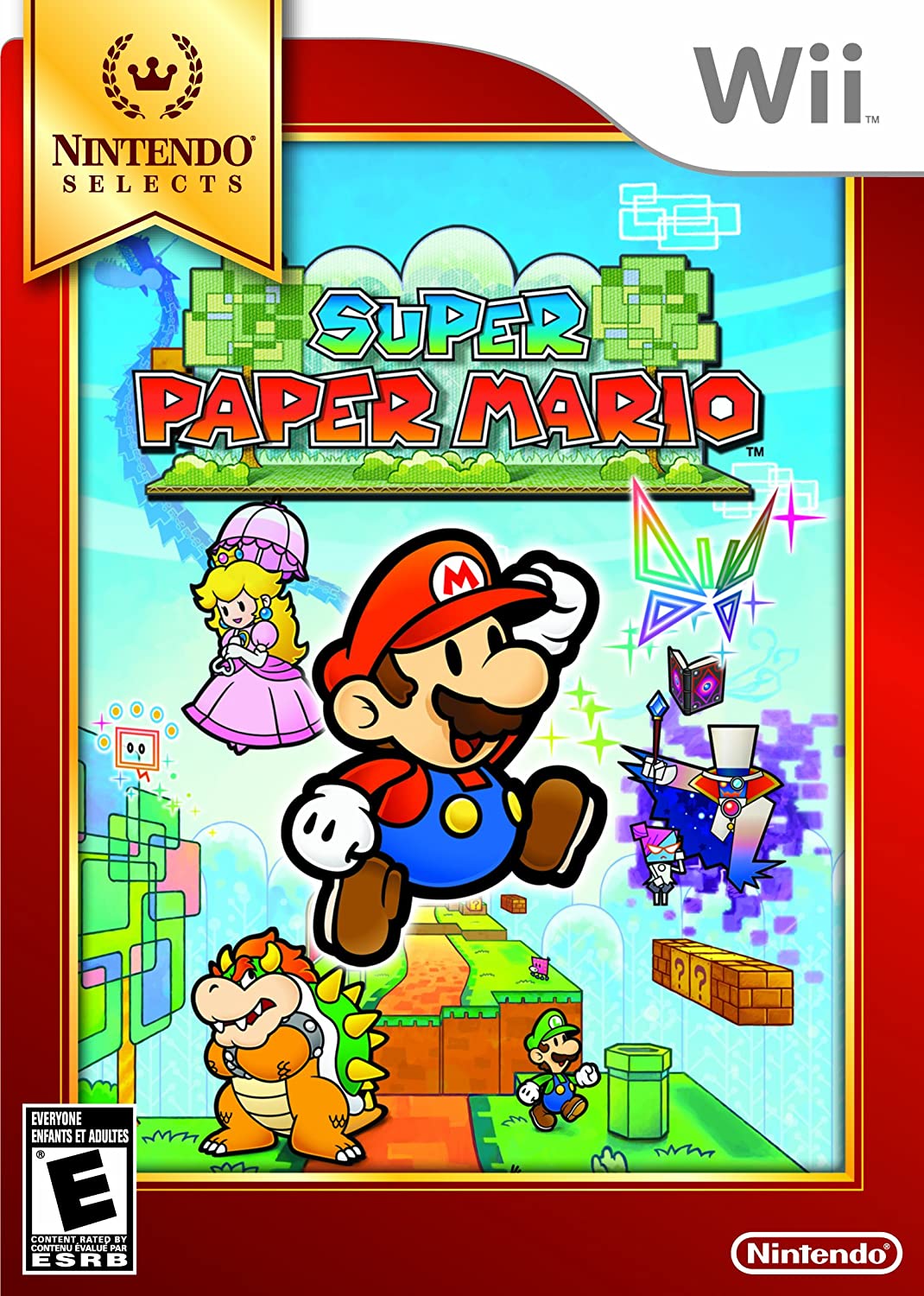
It wouldn’t take long before I’d move on to something more conventional. To that end, Super Paper Mario was the path to go. The third entry in the Paper Mario sub-genre, it was also the first to deviate from tradition and go for a linear platforming approach. Not that I’m faulting it, as I quite like this game. In some ways I even love it!

The story’s standard Paper Mario fare initially, Mario uncovers 8 Pure Hearts and saves all dimensions from being torn apart, but there’s more at stake than meets the eye. Specifically, there’s a subplot about the primary companion, Tippi, and the villain, Count Bleck, that feels ripped from Romeo & Juliet. It ends on a bittersweet note, though I wouldn’t be surprised if Intelligent Systems had been cribbing notes from the Shakespeare tragedy. I still cried at the end, though.

It’s a shame I got so invested in the story, because it often dragged me away from the gameplay. Which was…fine. I mean, it’s fun, and I’m glad I played it, but given how special those first two Paper Mario games were, it feels like a step down. It’s basically, when it boils down to it, another Mario platformer. Except that, this time, it has RPG elements. Yay Nintendo!

That was mean. Super Paper Mario is still lots of fun. Whether it’s the side-scrolling levels, or the puzzles that involve flipping perspectives or using the Wiimote in unique ways, there’s lots to enjoy. The game’s even funny, retaining much of the humour that made the Paper Mario games special. I especially like how many of the puzzles can be solved by switching from 2D to 3D. Though did the flipping mechanic need a health bar that drains so quickly?

I like Super Paper Mario. Is it a great game? Not really. But it does what it sets out to, letting you traverse a platforming RPG world. Plus, you can play as Peach, Bowser and Luigi. That alone sells me on it. 


Moving on from there, I made good on an old promise and started up Zack & Wiki: Quest for Barbaros’ Treasure. I’d beaten this game before many years ago, but I’d been hesitant to do it again because of its difficulty. And when I say that, I mean “chained to a walkthrough for most of it” levels of difficulty. Sufficed to say, I still got stuck constantly. So it was like playing another Zelda game, except it’s a point-and-click game.

The game follows Zack, an adventurous pirate, and Wiki, a magical monkey, as they travel with their group of rabbits. During an encounter with Captain Rose, who blasts them from the sky, the two of discover the head of Captain Barbaros. He promises them riches in exchange for finding his body parts, which have been scattered throughout four worlds. With fame on their minds, Zack and Wiki take on this naïve quest.

The game uses a repetitive formula: Zack and Wiki traverse a level, solve puzzles and collect the pieces of Captain Barbaros. The game, however, is unbelievably hard, so much so that, like I said, I was chained to a walkthrough for much of it. Even then, I died a lot. Sometimes it was funny, but others it could be frustrating to see myself make the same mistake over and over. Especially with that accordion music playing each time I died.

Fortunately, the puzzles never feel unfair. Even when they’re outlandish in concept-the animals turn into sodas that you bathe in in one level-they follow a pre-set logic that make them palatable. That’s already a leg up considering how I’ve yet to complete any other puzzle game, of which this qualifies. Yay me!

As a final note, the game looks breathtaking. It might be a 13 year-old game, but its cell-shaded aesthetic makes it look like it could’ve come out today. It feels cartoony too, with a Saturday morning vibe that compliments how silly it can be. That doesn’t mean it can’t be dark, it can be, but that contrast helps make moments of tension or seriousness palatable. Not that it matters, because Zack & Wiki: Quest for Barbaros’ Treasure is really fun! It’s the only point-and-click puzzle game I’ve beaten, and it’s a shame that it never received the sequel its ending teased. (I blame the bad marketing.) 


As the Summer months creeped up, I decided to go for a Virtual Console game on my Wii. Initially, I wasn’t sure which to choose. But I wanted something short, something I could beat in an afternoon. Then I remembered that I hadn’t played Pokémon Snap in a while, and my nostalgia funny-bone began tingling. After all, with a sequel coming next year, what better time to replay it?

Pokémon Snap centres around Todd Snap, a photographer who’s commissioned by Professor Oak-yes, that Professor Oak-to photograph Pokémon in their natural habitat on a tropical island. Armed with a camera, a trolley and, later, a series of items to make the experience smoother, you’re tasked with taking pictures of all 63 Pokémon, as well as the 6 Pokémon Signs scattered in the first 6 courses. Though why it’s only 63 Pokémon, I’m unsure. Maybe if they cut down on the number of Pikachus…

Despite being breezy compared to other rail shooters, Pokémon Snap has the one element most games in the genre lack: leisure. This isn’t a game involving zombies, nor is it a survival experience. The levels of violence are actually pretty toned-down. All you do is take pictures of Pokémon. That’s it.

Surprisingly, that’s all it really needs! Considering that HAL Laboratory, developers of Super Smash Bros., made such a fun concept around photography, I’m amazed more games haven’t tried it. It’s really relaxing, too! So why not capitalize on that? Are developers that scared to make a game centred around photographs?

Either way, this game’s a breeze in the best way. The only downside? Its length. That, and it took over 2 decades to get a sequel. It’d better be worth it, or I’m suing! (Not really, but you can see my frustration.) 


As you’re no doubt aware, I participated in a novel writing course this Spring and Summer. To celebrate finishing it, I played a game I personally was excited for: Paper Mario: The Origami King. I knew it wouldn’t be on-par with the classic entries, but I was anxious to play it anyway. And was it good? Yes.

Paper Mario: The Origami King starts with Mario and Luigi being invited to The Mushroom Kingdom for an origami festival, only to discover a ghost town. The kingdom has been hijacked by King Ollie, who’s kidnapped Princess Peach, turned everyone into origami creations and has trapped the castle in streamers. It’s now up to Mario, together with Ollie’s sister Olivia, to fix everything. Along the way, they interact with various regions and inhabitants, as well as liberate Toads from origami prisons. So yeah, it’s the most-Japanese Paper Mario game ever.

That’s not necessarily “bad”. If you can get past the bizarre concept, it’s actually quite fun. It’s especially satisfying to fill in holes with loose confetti or liberate Toads from origami prisons with your hammer. It’s especially satisfying if you’re persnickety, though that can also be a curse, maybe? I don’t know, it sometimes was a chore trying to 100% clear the game. (And I never did.)

That aside, the game has a really charming aesthetic that makes it worth traversing, even if only for a little while. I like taking side-routes and seeing what I could find, making this the first non-Pokémon RPG to do that for me. It didn’t matter if it was hammering trees or breaking blocks, the game’s overworld wasn’t boring. Neither were the NPCs, who felt distinct and fascinating in their own rights. And let’s not forget that one Bob-omb’s sacrifice, shall we? I’m still traumatized over that!

If I have any complaints, it’d be the combat and grid puzzles. The former wasn’t bad, but it got repetitive and often dragged on. And the latter was infuriating, since I hate those kinds of puzzles. Neither aspect ruined the game, the former kept battles exciting, but it’s no Paper Mario or Paper Mario: The Thousand-Year Door. (It’s not even on-par with Super Paper Mario, but I won’t fault it.) 


However, if you desire a traditional, Paper Mario-like game, look no further than Bug Fables: The Everlasting Sapling, which debuted on the Switch in the Summer of this year. I didn’t purchase to it until mid-Fall, as I was getting one of my Joycons fixed, but it’s still an absolute joy. It’s not flawless, and I’ll cover that eventually, but it fills the void left by what it’s emulating. And yes, it’s equally cute.

You play as Kabbu, a Hercules beetle, and Vi, a honey bee, as they fulfill Queen Elizant’s dreams of finding the Everlasting Sapling. You also find a moth named Leif, who joins your party after you save him. From here, you traverse the insect kingdoms in your quest to find different artifacts, as well as fight the various baddies along the way. It’s a pretty straightforward “go on a quest, travel to a new village, roam the land, fight the boss, rinse and repeat” formula, but, like the Paper Mario games, it works. It’s more repetitive, but it works.

For those unfamiliar, Bug Fables: The Everlasting Sapling’s a storybook-style, turn-based RPG with items and puzzle platforming. The combat’s also incredibly straightforward, almost a beginner’s RPG. Even the enemy battles are foreshadowed by making them visible in the overworld, though you can avoid them if you choose. It’s an example of one franchise stealing from another one, to the point of plagiarism. However, if it worked for the first two Paper Mario entries, then it works here too.

I have some complaints, though. Ignoring how some of the features from the Paper Mario games that I don’t like, like figuring out your enemy’s HP, make a return, I don’t appreciate how underpowered your party is. It seems like the developers weren’t happy with the system in the Paper Mario games and wanted to break it, and it shows. Far too frequently, I’d be up against an overpowered enemy, yet my party’s HP wouldn’t come close to matching it. And your EXP growth’s so slow and tedious that it doesn’t make it worth it. Not since Gen 2 of Pokémon have I felt this cheated by such an unbalanced levelling system, to the point where I’d be stuck on the same boss for hours and pray they didn’t pull a fast one on me. I know some gamers weren’t thrilled by how easy the Paper Mario games were, but it doesn’t make Bug Fables: The Everlasting Sapling feel as newcomer-friendly.

But I digress. The game has flaws that hold it back from being 5-stars, but I still enjoyed it. Sure, some latter sections had me chained to a walkthrough, which is disappointing for a straightforward game, but that’s a minor quibble. Even then, I frequently got lost in the artistry and beauty of this game’s world. It has lots of life and personality, which is nice. That alone makes it a worthwhile recommendation. 


Finally, we arrive at a game that I can’t help but love: LEGO Star Wars: The Complete Saga. I’ve enjoyed the LEGO Star Wars games since the first one in 2005, and this could well be the best. It might even, if we’re being honest, be the best Star Wars media ever. And yes, that includes the movies, some of which have been excellent. I’ll let that speak for itself.

The game’s pretty much a LEGO-ified retelling of the first 6 movies, which are all connected via an overworld hub meant to mimic The Mos Eisley Catina. There’s not much to summarize in terms of story, other than seeing the 36 main levels retell the films through the eyes of LEGO characters. It’s not only funny to see Eidos’s renditions of these stories, but it sometimes even surpasses the films. I don’t say that lightly either, considering how the films weren’t always known for their stellar acting.

It’s worth noting that the levels incentivize you to come back in Free Play Mode to unlock everything, be it getting your Stud Meter to 100% or finding all 10 Brick Canisters. In fact, it’s actually mandatory. Some sections can only be accessed with specific characters that are either unlocked by beating other levels, or by purchasing them with Studs. It’s a persnickety player’s dream come true, and there are side-missions and objectives that extend the playtime beyond the main game. Sadly, by the time I’m done the main campaign my patience wears thin, so I lack the urge to press onwards. But that’s a personal issue.

For those willing to play with a buddy, the game becomes more enjoyable in Free Play Mode. Whether it’s the Bounty Hunter Missions that are only accessible if you purchase all of the bounty hunters, or the Bonus Missions that add a variety of new objectives, there’s enough content here to last a month. Which is great, because there’s lots of charm to these characters that make experimenting with them worth your time. That, and having them fight one-another in the overworld hub is worth a laugh or two. (I won’t tell you how to enjoy yourself, though.)

Like I said, this is easily my favourite piece of Star Wars media. It’s not without flaws-the fixed camera’s both a blessing and a curse, and it’s definitely on the easy side-but that doesn’t detract from its strengths. LEGO’s always been known for childlike wonder, and LEGO Star Wars: The Complete Saga doesn’t disappoint. I mean, it’s LEGO tackling one of cinema’s most-enduring franchises of the last 40-odd years. What’s not to love?

That about does it for now. I’d mention my recent rounds of Super Smash Bros. Ultimate with my brother, but I beat that game years ago. Regardless, have a safe and healthy New Year’s, and I’ll see you in 2021!

Wednesday, December 30, 2020

The Manda-LORE-ian? My Thoughts

It’s been over a week, as of writing this, since I finished Season 2 of The Mandalorian. I’m conflicted on how it ended. On one hand, it feels like fan-centric overcorrecting meant to please those who were unhappy with Star Wars: The Last Jedi. On the other hand, it’s in-line with how Star Wars has operated for decades. Ultimately, I’m unsure how to react. And that hasn’t changed since I saw it.

By the way, I’m about to ruin plot points. This is your only warning. 


To give my thoughts, I first have to give a synopsis. Set 5 years after The Empire’s collapse, The Mandalorian follows a nameless Mandalorian bounty hunter who discovers a Force-sensitive child (named Grogu) on an assignment. Concerned, this Mandalorian breaks protocol and rescues him, leading to a target on his back from several other bounty hunters. From here, the Mandalorian develops a bond with Grogu, as he searches the galaxy for a suitable teacher. He also takes up odd-jobs, gets into trouble and meets recurring favourites and new characters. So, basically, it’s a Star Wars Western.

I should mention right now that I liked this show. I’m a dumb shill for anything Star Wars, even when it sucks, and this was no exception. Whether it’s the quirky characters, the memorable dialogue, the grounded action scenes, or watching the protagonist bond with Grogu, it was all really well-done. Special shout-out for expanding the lore while feeling like part of the canon, which can be tricky to do. Then again, Star Wars is really an elaborate D&D campaign.

I’ll also single out the main theme, composed by Ludwig Göransson. It plays at the end of every episode, and it’s interlaced with concept art for the episodes themselves. The theme’s a real banger, and it’s easily the best part. Then again, is that really surprising? Not exactly. 

What bothers me, however, is how calculated this show is. More-specifically, how calculated its fan-service is. It seems to be trying really hard not to anger fans and give them what they want, versus challenging them. It feels like it’s kowtowing to them, with moments and characters that reward long-time Star Wars nerds. It’s really safe in that regard.

The two best examples come into play in Season 2. The first is Boba Fett’s return, who “died” in a Sarlacc Pit in Star Wars Ep. VI: Return of the Jedi. I don’t hate this retcon, Fett’s “death” felt anticlimactic, but, like The Emperor coming back in Star Wars: The Rise of Skywalker, it’s a stretch. We’re not even given an explanation, and now he’s getting a show? Seriously?

The other is that final reveal of Luke Skywalker, where he takes down Darktroopers by himself on his way to Grogu. It’s the inverse of Darth Vader’s hallway massacre from Star Wars: Rogue One, except even emptier thematically. At least Vader’s slaughter made sense contextually, this feels like Disney kissing the feet of those who hated Luke in Star Wars: The Last Jedi. Except that I liked what they did, so what do I know? 

The show, for all it does well, feels emotionally hollow because of these decisions. And it, in turn, loses some of its narrative complexity. Even when the protagonist says goodbye to Grogu, which is meant to be a heartbreaker because he removes his helmet, it’s less-impactful because of the decision to bring back Luke with the same Uncanny Valley problem that Moff Tarkin and Princess Leia had in 2016. It’s sad when Star Wars Rebels, a show hampered by its age demographic, took more risks than The Mandalorian.

Nevertheless, I’d be lying if I said these issues killed the show. They didn’t. Seeing Bo-Katan again was fun. Seeing Ahsoka Tano again, if only briefly, made me feel like I was watching Star Wars: The Clone Wars again. Even the new characters, like Cara Dune and Moff Gideon, were likeable, and I see them becoming fan-favourites. This might be a fan-service-heavy show, but it’s done well. And I commend it for that.

I also recognize that Star Wars has always been about brand management. Since its inception, it’s remained relevant with constant call-backs and tie-ins to previous entries. Even when it treads new ground, it does so while maintaining call-backs to Star Wars of yesteryear. This, therefore, shouldn’t surprise me. After all, to paraphrase Patrick Willems, this is a fantasy story about space wizards for 12 year-olds. The pandering isn’t shocking by now. 

I guess I’d still like the IP to innovate a little more. The crux of Star Wars: The Last Jedi, learning from failure, relied on that. Sure, not everything worked-I’m looking at you, Snoke-but that it had the gumption to do what it did astounds me. I mean, Holdo going supernova and defeating an entire fleet by herself? Leia flying in space? Luke projecting himself halfway across the galaxy and fooling Kylo Ren? I don’t know about you, but I found all of this cool! And this is in addition to challenging how we perceived Luke as a Jedi.

But maybe I’m in the minority. For as much as I recognize that Star Wars, good or bad, is a brand, one filled with retcons and contradictions, I don’t want it to be The MCU. Because The MCU is The MCU, and it does that well. We don’t need another franchise to be that, let Star Wars be itself. Is that too much to ask?

Overall, I enjoyed The Mandalorian. I enjoyed it as much as I do most Star Wars content. But I didn’t love it, and I have no one but myself to blame. Then again, I didn’t mind Palpatine’s return because I thought his “death” was wasted potential. I’m consistently-inconsistent, so take what I say with a grain of salt.

Sunday, December 13, 2020

The Castle of Cagliostro Discussion | The Director Project

(Note: The following conversation, save for formatting and occasional syntax, remains unedited. It’s also laden with spoilers. Read at your own risk.)

2020 has been a frustrating year, hasn't it? Between a global pandemic, racial tensions and a buffoon politician leading the world's biggest superpower, it seems like humanity is never gonna catch a break. Fortunately, there's always media to keep us occupied. And what better than to jump on-board with a series of essays in December and discuss the first film from one of my favourite living directors: The Castle of Cagliostro? 


I should mention that this took a lot of work, as well as several disappointments and cancellations, to materialize. It wasn't even my Plan A for the December month of the year, that was reserved for something that never actually materialized. However, since I'm desperately itching to discuss some Hayao Miyazaki-related content (again), I figured I'd do exactly that. And I'm not alone, either! That's right, give it up for one of my more-recent acquaintances, and the man who single-handedly broke Twitter with an anti-vaxer roast: Old Chris Cringle himself!

Say hello, Santa!

Hi, and thank you so much for collaborating with me on this. I'll make a confession: before we talked about working on this together, I'd never heard of The Castle of Cagliostro, and I had absolutely no idea what to expect, but after watching it I'm so happy that you brought it into my life. It isn't often that I sit through a film just grinning, but this was so full of charm and whimsy, I can't imagine watching this and not enjoying it.

Indeed. Though it DID have to grow on me, but we'll discuss that shortly.

Anyway, I should note two things about this movie: firstly, it's a sanitized version of a long-running show, which also happens to be a fan-fiction spin-off of a French novel series. And secondly, it was Hayao Miyazaki's first feature film and second directorial work that he finished to completion...at the tender age of 38. I guess some people are late bloomers, huh?

Yes, I was a little apprehensive for about the first five or so minutes of the movie because it was clear that these were characters from an established series and I have pretty close to zero experience with anime aside from watching Akira a few times in high school and catching a little bit of Attack on Titan at a friend's behest fairly recently. I want to note for the record that I'm not anti-anime by any means; and I've even watched some anime-adjacent stuff with my kids, huge RWBY fan here, but growing up I just didn't have anybody in my immediate circle that was interested, so it isn't something I grew up with. But I don't want anybody thinking I'm somebody who looks down at it as an art form or anything like that.

All that rambling is to say, again, that I was a little nervous about not having any kind of pre-existing knowledge of what was immediately obvious is an established property. But that slipped away very quickly and I found this was like slipping into, say, a comic book from the 70s or early 80s: the writers did an incredible job of making these characters feel immediately familiar. Sure, I didn't know their history, but within the first few minutes I felt like I had a pretty good understanding of these characters and their motivations and what drives them. That isn't always an easy feat to pull off with existing properties, especially in our modern era where writers seem to have a tendency to want to dive into their knowledge of the lore rather than focus on telling a single comprehensive story. 

To your second point, Miyazaki pulling this off at 38 gives me hope that it isn't too late for me!

I hope so, I'm already 30!

But yeah, a lot of Lupin III fans are mixed on this movie. It strays very far away from what the franchise is typically known for, blood, sex and drugs, and goes for a more traditional, James Bond-meets-Robin Hood style of storytelling. Even Lupin, who's shown in a flashback in the third-act as his usual, more classic self, is more Miyazaki protagonist here than the typical, grope-y lecher that fans associate him with.

But that's not necessarily bad, though. I don't think classic Lupin, especially what he was in the 70's, would've aged well in 2020, what with Me Too being a thing now. So sanitizing him to fit more in-line with Miyazaki's anti-fan-service style of characterization makes it stand out more. Think of it as a side-adventure with an older Lupin, I suppose.

And I appreciate him for giving it that more family friendly tilt. In spite of the PG-13 rating, this is a film I'd be perfectly comfortable letting my kids watch-and I probably will; it's right up the alley of my 10 year-old in particular. I'm not of the mindset that everything needs to be tailored to children-Lord knows they have plenty of movies to entertain them-but I also think making something edgy purely for edginess' sake almost never holds up. How many people in the 2020s are saying positive things about, say, Fritz the Cat? If sex or drugs or graphic violence or superfluous vulgarity enhance the story and make sense for the plot, let's do it! But if you're just throwing stuff into there to show how edgy and adult you are, and it doesn't do anything for the story, I think it's less likely that you've created something that people are going to be coming back to generations later. I know peoples' mileage on this idea tends to vary.

One thing about this film that definitely stood out, watching it in 2020, is how comparatively little the women characters get to do. The Princess does get a couple of minutes of fleeting heroism that was probably ahead of its time in 1979, but in a world where we've become accustomed over the last few decades to take charge and kick ass heroines, it really stuck out to me how much of the film the Princess spent as the damsel in distress, and I'm fairly certain that if somebody held it up to The Bechdel Test, it wouldn't pass. But I also don't think the women in this film were negatively portrayed either, and they certainly weren't objectified in any way.


I have my issues with The Bechdel Test, but it's definitely something that Miyazaki would improve upon as his career went on.

I guess we can start with a general synopsis of the movie, in case some of my readers are unfamiliar with it. And fair warning, there WILL be spoilers. Can't be a discussion without them, can it?

Spoiler warning for this now 41 year-old film! You've been warned!

You'd be surprised how many people still haven't seen it, Chris. Anyway, why don't you take it away? 

The gist of the film is that our protagonist Wolf (although I don't think that's his actual name), a thief with a heart of gold, and his sidekick, whose name I did not catch but spends most of the film being extremely laid back and also chomping on cigarette butts-another sign of the films age is that these characters are constantly smoking-decide after getting bamboozled by counterfeit bills on their recent heist to drive into the tiny country of Cagliostro, where they've deduced the bills have come from, ostensibly to steal the counterfeiting equipment. However, they get quickly sidetracked by a chance encounter with a young woman wearing a wedding dress trying to escape from a bunch of soldiers. Wolf manages to briefly rescue her, but in short order she's gone again and what started as a fun if somewhat criminal caper turns into a rescue mission and our heroes realize there's a connection between the Princess, the arrogant count she's being forced into marriage with, and the counterfeit money that brought them there to begin with.

I should note that Chris and I watched two different versions of the English dub. It's complicated, but due to licensing issues, the one available on Netflix is the older, crustier dub with the weird names for the characters. But yes, Wolf's real name is Lupin III, and his buddy (not sidekick) is named Jigen. The Bride is also named Clarisse, and The Count, apparently, is her cousin, I think?

Yeah, there's some weird stuff in that Streamline dub that the Manga Entertainment dub cleaned up. It's too bad that that dub's not more readily-available these days...

Anyway, it's very much a James Bond-meets-Robin Hood type of movie. But it's fun! And I especially like that chase at the beginning with Lupin and Jigen in their...is that a Fiat? I think it's a Fiat. (I'm not very well-versed in cars, as I don't drive.)

I'm pretty sure you're right; I think it was a Fiat. I also think your analogy was pretty spot on there, but I'll just add a little to it: James Bond meets Robin Hood with a generous splash of Uncharted mixed in. Definitely picked up some strong Nathan Drake vibes from Lupin, and it struck me at several points throughout my viewing how much influence this film has probably had on video games in general. The movie's climax takes place both outside and inside of a clock tower, and it invoked in me strong vibes of Assassin's Creed and the Mario games, respectively.

And not to derail this conversation into video games but as an aside: were any of the artists on this involved with the marketing for the original The Legend of Zelda? I'm old enough to remember perusing through the instruction booklet (remember those?) for that game, and the similarities between the art on this movie and in that game-especially with Clarisse-were uncanny.
 

I have no idea. I WILL say that that clock fight inspired the one in The Great Mouse Detective. Bet you didn't know that!

I didn't! But that just makes me appreciate it that much more. It was a great scene. All of the action scenes in this movie were really well done, honestly. It felt a little bit like watching a Fast and Furious movie: if you're willing to suspend disbelief, there's a lot of holding your breath, edge of your seat close calls.

Yeah, the movie inspired a lot of Western animators and directors. The box cover for the movie even has a quote from Steven Spielberg singing its praises.

But yeah, I like the "grounded goofiness" of the movie's world. It's silly enough that Lupin and Jigen can do aerial jumps over poles that aren't physically possible, yet tangible enough that a shot to Lupin's chest can lead to a stream of actual blood. Though I'll say this: the fact that Lupin recovers from amnesia in the third-act so quickly has always bugged me. I've volunteered in an old age home for many years, and amnesia doesn't go away that quickly...

I did enjoy that he was so banged up and badly injured at one point that they'd essentially mummified him, and then he sits up and says "let's go" and that's the end of it. Wolverine-esque healing factor, and I respect it.

But jokes aside, Spielberg is a heck of an endorsement and it makes me wonder why I'd never heard of this movie before you put it on my radar. Am I living in a bit of a bubble or is this something of a niche film flying under the mainstream radar, and if it's the latter, why? It's so good, much more enjoyable than anything Disney was putting out in that time (I'm a moderately big Disney fan but I don't think anybody is in denial about what a dry period it was for them post, I don't know, 101 Dalmatians maybe, all the way up to whenever The Little Mermaid came out).

I know that Americans tend to be way too western-centric in the media they consume and were much more so back then, but even in an age where foreign films tend to become cult classics over here, I've never seen or heard any buzz for it and that's disappointing because it's a genuinely fun and delightful experience.
 

Like I said, it's niche even by Miyazaki's standards.

I'd like to point out something real quick here too: this movie was cobbled together in 6 months, yet has the polish of a movie that was in development for double that. It's not without its limitations, some of the animation fluidity feels a little stiff nowadays, but it's proof that you don't always need a big budget to make something special.

That's incredible. With the exceptions of the few things we mentioned earlier that do make the film feel a little dated, this has the overall look and feel of something that easily could have been released in the last five years. Obviously it isn't computer animated, but like you just said, it's remarkably polished. To be put together in such a narrow window of time is pretty astonishing.

I wouldn't go quite that far, but it definitely looks like a mid-80's film. It also has an excellent use of colour for something made on such a tight budget. It's clear the small team at TMS Entertainment that worked on it really cared.

Yeah, on reflection, you're right, I'm overselling it a little bit. But also if I went in completely blind, there's not a chance I would have guessed 1979 and certainly no way I'd think, "This entire film was made in a mere 2/3 of the time it takes a human being to have a child".

Indeed.

I guess we can focus on the character themselves. I know we've already touched on Lupin and Jigen, as well as Clarisse, but I think a lot of the credit goes to Detective Zenigata and Fujiko as well. I know that fans of the Lupin III franchise take issue with how dumbed-down Fujiko's sex appeal is here, as well as how she's now a blonde instead of a brunette, but I think it works with the kind of story Miyazaki's telling here: she's the Player Two to Lupin's Player One, a sort of friendly rival in the game of thievery. She also, interestingly enough, is the one who ends up winning the game in the end, not Lupin. 

As for Zenigata, he's the stereotypical, dedicated cop trope in film form, always over-dedicated to his job. He's so dedicated that he's willing to defy Interpol and arrest The Count once he finds out that he's the one responsible for the counterfeit ring of goat bills. I also like how he exposes the hypocrisy in political affairs when he's advised not to pursue his job because Cagliostro is a protected country, only to have the UN leaders bicker over their vested interests in these bills. (Also, is it just me, or does the American representative look a lot like Reagan?)

Fujiko was a really fun character and while I understand why she wasn't a bigger part of the film, I kind of wish she had been. It's odd to me that anybody would have a problem with a character who is essentially a professional thief periodically changing their appearance to evade the law, but hardcore fandoms are going to hardcore fandom, I guess. Anyway, I agree with you that the friendly rival dynamic worked well here; I think between The Count and Zenigata, Lupin's hands were already full and a third antagonist would have been overkill.

Zenigata was a stellar character in this, too, like you said absolutely nailing the cop-that-lives-for-his-job trope but also displaying a good sense of self-preservation and a code of honor. Even while I spent the entire film rooting for Lupin, at no point was I necessarily rooting AGAINST Zenigata. Calling their dynamic in this film similar to, say, Bugs Bunny and Daffy Duck doesn't really feel entirely wrong, even though it doesn't feel entirely right, either. I got the sense that Zenigata knows somewhere deep down that he's better off being the dog that's chasing the car when it comes to Lupin; and in crunch time he was all in on taking down The Count.


Bugs Bunny and Daffy Duck, with a bit of Wile E. Coyote and The Roadrunner for good measure. They begrudgingly work together to stop Count Cagliostro, but at day's end they're still enemies.

Speaking of Count Cagliostro, we have to mention him. Miyazaki's only ever done a traditionally evil villain in his films twice, and this guy's one of them. He wants to marry his underaged cousin against her will so he can inherit her bloodline, and he has his stereotypical henchmen in Joto and Gustav. He even peels away his layers slowly as the film wears on, to the point where he's actually quite threatening in the climax.

Though his death...man, talk about a brutal chef's kiss!

His slow evolution throughout the movie from rich, arrogant dickhead to genuine sociopathic menace is another testament to the strength of the story. In animation, we typically get loud, bombastic villains that chew up the scenery. The Count was decidedly not that but I think that's what makes the final act of the film more effective. I'm always a sucker for villains being undone largely by their own hubris and poor decision making. His death was very satisfying. One thing we didn't really talk about was his small army of ninja(?) assassins! I can't really articulate how but they were one of the standouts of the movie to me. Their visual style was distinctive and there was something just really unsettling about them. They should have been our first clue that The Count was bad news. Not just any villain is going to have a pack of those things running around the castle.

I also like how Lupin, essentially, wears The Count out by...being himself.

If I have any personal complaints on the character side, it's probably Goemon. He's cool, slick and badass, but he's not in the film all that much. And he gets very few lines to boot.

I was completely perplexed when Goemon showed up. I was trying to figure out if I'd somehow missed something. This whole caper has been Lupin and Jigen and then suddenly here's their pal who almost looks like he just walked off the set of a Street Fighter game. Was it ever explained where he'd been for the entire first hour of the movie? This was before cell phones so I know he didn't just get an "off on an adventure, meet us at the castle to fight ninjas at 5:30!" text. Was it just a thing where they were trying to shoehorn a little more in for the long-time fans and just had to hope it made sense?

If I recall, Goemon usually tags along as backup in Lupin's adventures. He also tends to keep largely to himself, so as to avoid detection from police.

As you do, when you're a good-hearted thief who lives outside the law. I respect it. We should all be so lucky to have a friend who shows up when we're besieged by a gaggle of ninjas.

Touché!

Speaking of characters, I'm curious what you thought of the voice acting. Having watched two different tracks of the movie, we're probably gonna differ on that.

It was fine. Nothing to laud, nothing to loathe. Like I mentioned earlier, my background in anime is pretty scant, but if I learned one thing from my co-workers over seven years of working at GameStop, it's that people have incredibly strong opinions about watching the English dub and those feelings overwhelmingly seem to tip toward "don't!". But there wasn't anything in this that came off as especially bad. I suppose we've been spoiled by 30 years of animated films that rely heavily on celebrity voice casting but I had no lofty expectations and was not disappointed.

Interesting. I've seen bits and pieces of the Netflix (or Streamline) dub on TMS's YouTube channel, and I remember finding the voice acting a little crusty and flat. Perhaps the most-notable thing about it is that one of the original voices for Mario was in it.

As for the Manga Entertainment dub, which is hard to find now, it's actually quite good. The VAs ad-lib several lines that weren't originally in the script, and there's a bit more profanity in it, but it has really good voices performing really well. I especially like how the voice of Solid Snake was chosen for Lupin himself. 

David Hayter? Interesting! If I re-watch this anytime soon, I'll seek that cut out. The Netflix cut is pretty light on the cussing. They say "Hell" a couple of times and I think that's it. I'm pretty sure the PG-13 rating (which didn't even exist in the 70s) is pretty much exclusively because these guys smoke like they're on an episode of Mad Men. I'm a sucker for good ad-libbing, though.

Believe me, some of the best lines were ad-libbed:

"Dad? I'm not THAT old!"
"Well, I do think of you as a father figure."

"I forgot to mention the potholes."
"I bet you also forgot to mention the piranhas and crocodiles!"
"Hey, shut up!"

Really makes it for me.

I missed out on all the fun. Which isn't to say there weren't a few lines of clever dialogue that got me chuckling out loud, but I don't recall anything endlessly quotable. I'll remember this way more for the story beats than for anything anybody directly said. I did really enjoy the exchange at the end of the film where the Princess has become an enormous simp for Lupin and he's just like "wow thanks love you like a little sister". I think we've all been shot down in a similar way a time or two in our lives.

Well, maybe not Idris Elba. That man is astonishingly handsome. It is, frankly, unfair that we have to compete with that.


Hah!

And while we're on it, what'd you think of the music? It's not Joe Hisaishi scoring it, that starts with Miyazaki's next film, so it's not quite as memorable as Spirited Away or Princess Mononoke, but it's got some really good, light jazz going for it.

It wasn't anything terribly memorable but it was mellow and airy and suited the movie well, I thought. It's not anything I expect to catch myself humming at my desk at work but if I can be brutally honest, Disney is so hell-bent on making each successive movie out-earworm the last that it's really a pleasant change of pace to watch an animated film with no real musical number to speak of, just appropriately moody background stuff you don't even really have to notice unless you want to. 

It also, unlike Disney movies, shuts up on occasion to let the natural sounds creep in. I like that!

A novel concept and one I wish more animated movies today would consider.

Yeah...

I guess I'll ask you this now: was there a specific moment or two that caught your fancy? I happen to really like the Fiat chase, but I'm also fond of the clock fight.

Both worthy scenes, but I think the one that absolutely tickled me the most was when Lupin disguises himself as Zenigata and then tricks The Count's men into chasing down and beating up the real Zenigata while he slips into the castle. It got a good guffaw out of me and plays into that Looney Tunes dynamic with them that we talked about. I also remember one of the characters, probably Lupin, at one point attempting to swim upstream into the flow of a fountain and that got me good.

It helps that the film, true to Miyazaki form, has excellent spatial geography, enough that I can picture in my head where specific scenes take place relative to one-another.

Leading back to my point I made earlier, I actually have a confession to make: I didn't love this movie the first time I watched it. I actually almost shut it off about 40 minutes in out of boredom, only stopping myself because my instincts took over. I ended up not regretting it at the end, but the movie had to grow on me.

Even now, while I love it, it's not my favourite from Miyazaki. I, honestly, would've even pulled out that clip from Spider-Man 2 where J. Jonah Jameson laughs at Peter Parker's request for an advance a few years ago if someone had called it one of the best action movies ever made. It's still excellent, yes, but the man's made better movies since. Then again, he's also made worse movies, so...

Interesting that we had such different initial impressions of the film. Did you have pre-existing familiarity with the franchise? I wonder how much seeing it in a vacuum affected my experience. I think not having any kind of expectations was probably a boon. 

Now it's time for my confession: this is only the second Miyazaki film I've seen. The only other one was My Neighbor Totoro, which I watched at the beginning of the COVID outbreak with my kids and which I enjoyed but wasn't blown away by. It was touching and I was charmed, but I think my kids connected it with it a lot more than I did. I think that looking at them objectively, My Neighbor Totoro is obviously a better film, but I found The Castle of Cagliostro more subjectively entertaining.

To answer your question: no. I'd probably have never even picked it up had it not had Hayao Miyazaki's name on the cover (this was back in early-2011, when I was relatively new to the works of Miyazaki.) I'm also not surprised by your confession, since My Neighbor Totoro really only fully-clicked with me after my dad's heart attack 6 years ago.

I guess I also think the film itself could've used some ironing out. A lot of it's excellent, but you can sort of see the 6-month crunch in certain places. Bless the crew on board for caring, but even by Miyazaki's own standards this is pretty basic. It's really just a pleasant side-romp and stepping stone for a greater career down the road, and you can see it in how much the director wanted to be his own boss free from the restraints of typical anime production.

That's not to say there isn't his usual thematic fingerprint here, though. There are definitely ideas of the fickleness of money and the incompetence of politicians at play, and they're both quite effective. But I guess between the story being paper-thin and Clarisse's relationship with Count Cagliostro qualifying as jailbait...I dunno, I guess I'm being stingy when I call this beneath Miyazaki on a superficial level.

There was a lot about everything surrounding Clarisse that wouldn't pass any kind of smell test in 2020. The character herself was fine, but what you mentioned about her being pretty clearly underage and how that's treated almost as a gag as it was winked at by Lupin in one scene was a bit uncomfortable. But also, it's virtually impossible to enjoy anything produced before, I don't know, 2014 or so if you're going to hold it up to modern purity tests. So I didn't let it become something that took away from my enjoyment of the film for what it was, but it's probably something that should be mentioned for anybody who has never seen this and is on the fence about watching. 

Yeah, it's possible I'm also being really stingy and unfair. Either way, it's still lots of fun. And like I said, Miyazaki's done both better and worse since then. Anyway, closing thoughts?

I'm truly glad you got me to watch this movie. It had a little bit of everything: comedy, action, adventure, and even a little emotional heft. Is it The Shawshank Redemption or Goodfellas? Well, no. And the characters, while fun, aren't going to live in my head rent free like Jason Voorhees or Indiana Jones do. But I think it deserves to be seen and enjoyed on its own merits as the fun, light-hearted romp that it is. I don't think it's something I'm going to go back to endlessly over the years, but I'm looking forward to showing it to my kids in the near future, and between it and My Neighbor Totoro I'm very much looking forward to exploring more of Miyazaki's work.

Believe me, it's only uphill from here.

As for me, despite any issues I might have with facets of it, I don't want anyone to think I'm being unfairly critical of The Castle of Cagliostro. It's a pleasant side-romp in the Lupin III franchise, contrary to what diehards may say, and it's still lots of fun. If anything, I'd say to give it a watch for that Fiat chase in the first-act alone. That short sequence is already a mini-masterpiece outside of the rest of the movie. In short, I give this movie a pretty solid 4/5.

I'm curious if you'd agree on the score.

I think that's pretty fair. It would be in the 3.5-4/5 scale for me as well.

And I'd ask the diehards to put aside their preconceived notions of what they think these characters should be and try to enjoy this movie for what it is.


Preaching to the crowd there, Chris.

A big thank you again for helping me out with this piece. I know it wasn't easy working around your schedule, or mine, but I appreciate you doing it anyway. Any last words you want to say before we end this?

I am just as appreciative of you for asking me to collaborate! I enjoyed this immensely, and I hope your readers do as well, and hopefully we can work together again in the future. Hopefully in a post-COVID world, and hopefully that world is around the bend! Thanks! 

From your lips to God's ears. And remember, do track down the Manga Entertainment dub at some point. It's really good!

But anyway, I'll see you all next time...whenever that is (hopefully soon, since I like writing opinion pieces.)

Popular Posts (Monthly)

Popular Posts (General)