Sunday, April 16, 2017

The Songs of Egypt: A Passover Special

Happy Passover! As of writing this, we’re currently in the midst of the most stomach-ache inducing holiday in the Jewish calendar. So while you’re busy chewing TUMS and GAS-X pills to alleviate your upset constitutions, all-the-while cursing your inability to eat real food, why not reminisce about arguably the greatest Passover movie ever made? And no, it’s not The Ten Commandments, although good try! No, I’m talking about this gem instead:


To those who don’t know, i.e. all three of you, The Prince of Egypt is one of my favourite animated movies. It ranked at #5 on my now-illegible list on ScrewAttack, and with good cause: it’s excellent. It’s not flawless, mind you, but the movie’s so good that I even once tried, albeit unsuccessfully, to write a blog on it a while back. But the desire lingered, so I figured that I’d write a different blog on the film’s best aspect: its songs. So here’s me ranking them from worst-to-best and discussing each one. The movie has no bad songs anyway, so why not?

Keep in mind that this is a personal list. If you disagree with it…go write your own. No really. Anyway, let’s get started!

7. “I Will Get There”

Courtesy of Karly Emily.

So remember when I said that The Prince of Egypt had no bad songs? I lied. “I Will Get There” is the sole bad song. It’s not flat-out atrocious, or even the worst ever, because it’s not. But it suffers from a serious setback: it reeks of the 90’s. And not in a good way.

I’m not kidding! Listen to it and tell me it isn’t the most-90’s song ever! I think that’s because, like “I Believe I Can Fly” from Space Jam, it’s not all that deep or compelling. It’s fitting that I mention that, especially considering that both songs were sung by 90’s pop sensation Boyz II Men. No really, that’s what they’re called. And it’s hilarious.

I haven’t touched on the song yet, so I’ll be brief and say that it’s nothing special. Boyz II Men had a fatal flaw in that for as ridiculous and forgettable as their name was, their songs were more-so. “I Will Get There” is the epitome of that, saying little-to-nothing about the movie. It only serves as a excuse to pad the credits, which it does. Moving on.

6. “When You Believe”

Courtesy of peepo23.

And now we get to the controversial ranking. Why? Because I utterly loathe “When You Believe”. It’s not a bad song, it’s excellent, but ignoring the credits' Whitney Houston/Mariah Carrey cover, it has the misfortune of being over-sung at family gatherings. I love my cousins, but they don’t know when to stop singing it. And they butcher it constantly. And one of the lines happens to contain the name of one of them, so it’s always awkward when that part is brought up. I usually end up caving in an attempt to correct them, but awkward embarrassment is awkward.

Ignoring that, “When You Believe” kicks off the denouement of The Prince of Egypt in fitting style. Considering that this is the earned redemption for the Israelites, you’d better believe that it’ll be thankful and powerful. It starts slow and quiet, as a duet with Miriam and Tzipporah, but quickly goes into a full-blown chorus when the children pitch in. By the final stanza, it’s an epic. And it’s amazing because of that.

That having been said, if I have a quibble, it’s that it uses God’s prayer name. Considering that it’s sacrilegious to use God’s prayer name in Judaism when you’re not praying to God, those lines are always a little uncomfortable. Even as a kid I’d be frantically searching for a yarmulka to wear when that part came on. These days I wear one anyway, but it’s still jarring. Other than that, no complaints.

5. “All I Ever Wanted”

Courtesy of Nicole Rey.

“What?! You’re placing ‘All I Ever Wanted’ above ‘When You Believe’?! Are you crazy!” Firstly, my list. And secondly, I already explained why I did that. Besides, I actually think that this is one of the more under-appreciated songs in The Prince of Egypt, specifically because it’s so low-key.

And yet, that’s kinda why I like it. It’s not only low-key, it’s also intimate in a unique and charming way. It’s sung from the perspective of a confused Moses, having been told who his real family is, and is pretty much him in denial. The entirety of the ballad reconciles the house he grew up in with reality, coming to the conclusion that he doesn’t care before dozing off to sleep near the chamber of etchings (which, by the way, leads to a powerful sequence. But that’s not relevant right now.)

As a side-note, I also like the reprisal with Moses and his adoptive mother for two reasons: firstly, it’s a nice bonding moment between adoptive mother and adoptive son, showing that she still loves him despite having lied all these years. Anyone who’s ever been adopted can instantly relate, especially if the adoptive parents are on good terms with them. And secondly, the reprisal ends with a subtly-inserted jingle that hearkens back to the movie’s opening cue. Considering that the running motif with Moses for the first-act is him slowly learning the truth about who he is, it’s a nice callback. All-in-all, a fitting companion to a fitting ballad about ignoring your heritage.

4. “Through Heaven’s Eyes”

Courtesy of Łukasz Frączek.

Much like “All I Ever Wanted”, “Through Heaven’s Eyes” is personal and low-key. Unlike “All I Ever Wanted”, “Through Heaven’s Eyes” is also a powerhouse song that marks the halfway mark. It’s the montage/time-skip sequence that animated musicals tend to be known for, but it’s not wasted space. A lot happens in it, namely Moses adjusting to life in Median and marrying Tzipporah, that serves to set up the more powerful and action-filled second-half. And it does this under the guise of Jethro recounting a life-lesson about one’s place of life.

Like I said, not a single moment is wasted: Moses starts as a guest in Median. He takes up residence and flirts with Tzipporah. His beard grows, signifying lapses in time. He eventually courts Tzipporah in a dance, followed by a silhouetted conservation with Jethro about marriage arrangements. The montage then ends with the marriage itself, followed by dancing and a pan upwards into the night sky.

And all of this in a few minutes. It’s pretty much the Biblical, animated musical version of “Married Life” from Up, except upbeat instead of sad. Regardless, it’s equally as powerful, with some concrete character building and little spoken dialogue. If the first-half of this movie’s about Moses finding his way, and the second-half’s about Moses saving the day, then this is the halfway point where he’s content with his lot in life. As an audience member, it’s also needed downtime before the heavy material.

3. “Playing with the Big Boys”

Courtesy of Teresa Gonzalez.

The Prince of Egypt has a wide variety of songs that elicit different reactions. Some, like “When You Believe”, evoke a feeling of grand, earned belief. Others, like “Through Heaven’s Eyes”, elicit contentment with Moses’s lot. Even others, like “All I Ever Wanted”, create a connection through confusion and uncertainty. Then there’s “Playing with the Big Boys”, which isn’t only a showcase for parlour tricks and editing that plays to the strengths of animation, but is also the epitome of cool in general.

The song’s biggest strength is slyness. Ramses’s priests could’ve easily used gone for a grand number and it would’ve worked perfectly. They could’ve also not sung at all and it would’ve worked. But they decide to be more sadistic and, like the showmen they are, tempt Moses into submission with their display of magic. Everything about this, right down to the use of shadows and lighting, screams devious and manipulative. And it’s awesome.

Of course, it’s also back when Ramses still thinks Moses is joking. We know better as the audience, but why not humour us? Moses was notorious for being a joker, so play to his mischievous nature with some dramatic irony! It’s a cleverly-written, sung and animated sequence in a movie already filled with those. Best of all, it’s fun.

2. “The Plagues”

Courtesy of Nicole Rey.

It was tough picking my runner-up. In the end, “The Plagues” lost by a small margin. Don’t get me wrong, it’s fantastic in its own right! But it’s not as good as my #1 spot. That said, “The Plagues”’s biggest strength is its grandness.

I’m not kidding: the animation is grand, showcasing the horrors of destruction and chaos of the plagues. The use of lighting and shadows is grand, especially when contrasting the reactions of Moses and Ramses. And the lyrics are grand, with Moses and Ramses duking it out via a variation of “All I Ever Wanted” from earlier in the movie. There’s no way around it, this is a grand song!

I think what holds it back from the top-spot is that it has a crippling flaw: the chorus. Which, don’t get me wrong, is still excellent, really driving home the stakes. But the lines are said so quickly and/or quietly for the majority of the song that it’s hard to make out what they’re saying most of the time. I, honestly, thought that the opening lines were “a syphilis” over and over for the longest time, and it stayed that way until I looked them up online. Even now, I still can’t get them right! But it’s a small quibble for the runner-up to my favourite song in The Prince of Egypt

1. “Deliver Us”

Courtesy of Jessica van den Brand.

Be honest: you were waiting for me to mention this. I can’t lie: while many musicals have had grand opening numbers, none hit me quite like this. I remember a YouTube video describing “Deliver Us” in the vein of Les Miserables’s opening number, and it’s not hard to see why. And truthfully, it’s as perfect an opening as you can get for a film like this anyway, with the song transitioning from powerhouse chorus, to somber ballad, to powerhouse chorus, to emotional lullaby and then back to powerful chorus without feeling awkward. It’s so great that, aside from setting up the inevitable pay-off of “When You Believe” in the third-act, it can easily be broken up into three parts akin to a three-act story on its own: the set-up, Yocheved’s lullaby to Moses and Miriam’s prayer for Moses once he’s found by Pharaoh’s wife.

Actually, let’s focus in on that second part. Not only is it the emotional high-point, containing a lullaby that resurfaces a few times in the first act, but it gives you a chance to hear the late-Ofra Haza. Her voice resonates because of how much raw energy she has, and she even provided the singing voice of Yocheved in several other languages. It’s also a real shame that this was her big break before dying of AIDS, as we never got to witness her full-potential. But you can’t change the past, so…

If there’s one detail that binds “Deliver Us” together, it’s its narrative cohesiveness. Like I said with “Through Heaven’s Eyes”, this works as its own short-film in that it flows in a complete arc: there’s the opening that sets up the conflict, the star the story centres around, the song that sets up stakes and a thematic resolution and a hopeful-yet-open-ended conclusion. “Deliver Us” is only the beginning number, but it’s so well-structured that it could’ve been its own piece without much trouble. It’s that good. And while it might be unfair to have the opening cue be at my top spot, I dare you to disagree. Because it really and truly sets up why The Prince of Egypt’s as good as it is.

So yeah, that’s my ranking of The Prince of Egypt’s songs. Have a happy Passover!

Sunday, April 9, 2017

Collect-a-Laylee

I’d like to preface this piece with a disclaimer: I haven’t been much of a gamer in years. I purchased a WiiU last year, and I enjoy the games I have for it, but I haven’t had the enthusiasm I used to in close to five years. I guess I’ve moved on, a fact made that much easier by gaming culture having become really toxic (more on that another day). So anything I say from here-on in must be understood with that lens.

Anyway, let’s talk about Yooka-Laylee:


So Playtonic Games, comprised of former Rare Ltd. employees, decided to create a retro-style video game platformer via crowdfunding. Said game would emulate Banjo-Kazooie and Banjo-Tooie in aesthetic and mechanics, and for many, especially after the initial trailer, this was the Banjo-Threeie they never got. The anticipation was high, and people were expecting a grand masterpiece…until reviews came in.

I’ll say now that people’s fascination with Metacritic astounds me. Its system of weighing averages doesn’t make sense when the site refuses to show its calculations, and its numbers come off as arbitrary because of that. I find that plenty of games the site was unfavourable/mixed on were, honestly, a lot of fun (like Yoshi’s Wooly World). Not that I begrudge the reviewers featured, mind you, but…moving on.

I mention this because Yooka-Laylee’s reviews weren’t even that bad; on the contrary, they were decent. But the underlying concern seems to be the same: its aesthetic. Many critics felt as though the style of platformer it pays homage to, the 3D, open-world collect-a-thon, doesn’t work in 2017. Video gaming has moved on, so shouldn’t this be considered obsolete? Is there a need for this anymore?

Personally, I’m not a big fan of collect-a-thons to begin with. I never have been. For one, I’m terrible at video games. I enjoy them, but I find it takes me longer than many of my peers to complete them because I get stuck so much more frequently than I intend. And two, collect-a-thons are tedious. My goal with a video game is to enjoy the experience, and collect-a-thons get in the way by making everything a chore.


I’ll use two examples, one past and one recent, to demonstrate this. The first is Donkey Kong 64. Considered one of the best Donkey Kong games ever, let-alone one of the best games on the N64, Donkey Kong 64 thrives on collectibles. There are eight worlds, as well as an overworld, and the developers, Rare Ltd., reasoned that jamming them full of collectibles would entice exploration and create a fun challenge.

This isn’t a bad idea in theory, especially with five playable Kongs that you can swap via DK barrels, but the complication comes in execution. Each of the eight worlds has 500 specially-coloured bananas, or 100 per character, that are needed to unlock the level’s boss battle, as well as 5 Golden Bananas for each to find either via mini-games or special objectives. On top of that, 5 of these Golden Bananas per level are blue print bananas that can only be found by defeating certain enemies to encode a map of King K. Rool’s ultimate weapon. If that’s not bad enough, there are special medals scattered throughout, special balloons that reveal bananas, special coins that act as currency scattered throughout, fairies that have to be photographed to increase health and stamina, film canisters to photograph them, crystal coconuts that increase your Kongs’ special powers, specially-marked ammo boxes for each of the Kongs’ weapons, music notes for each of the Kongs’ musical instruments, watermelon chunks that restore health, oranges that act as grenades and one DK Star per level that triggers a special mini-game. And that’s not forgetting the respective power-ups, musical instrument upgrades and weapon upgrades that each Kong accesses over time. Oh, and did I mention that there are 2 secret medals that need to be found via special mini-games to access the final boss?

If it sounds like that last paragraph was dense and complicated, don’t worry: it’s even worse in-game. Not only do you need all of those items to 100% complete the game (or 101% if you find the secret Golden Banana), but the items are scattered so haphazardly that completing tasks requires swapping Kongs constantly. It usually requires backtracking, swapping out, collecting what you need, backtracking again, swapping out once more, collecting what you couldn’t access before, backtracking a third time, swapping out again, backtracking a final time, swapping to your first Kong and continuing onward. It’s gruelling and frustrating, and while it’s neat in theory, in practice it makes Donkey Kong 64, a relatively fun and well-designed game, a nightmare to finish. I haven’t played it in years, but even as a kid that sort of swapping was tedious.

I’ve heard many defences of the game mechanics: it was because of technical limitations. The game’s flawed, yet the good outweighs the bad. People are being overly-critical in hindsight. While I understand the first defence and sympathize, the second is subjective and the third is harmful to discourse and the advancement of gaming as an art-form. But if me picking on Donkey Kong 64, an almost 18 year-old game, is being “unfair”, then don’t worry: I’ll attack LEGO Star Wars: The Complete Saga instead.

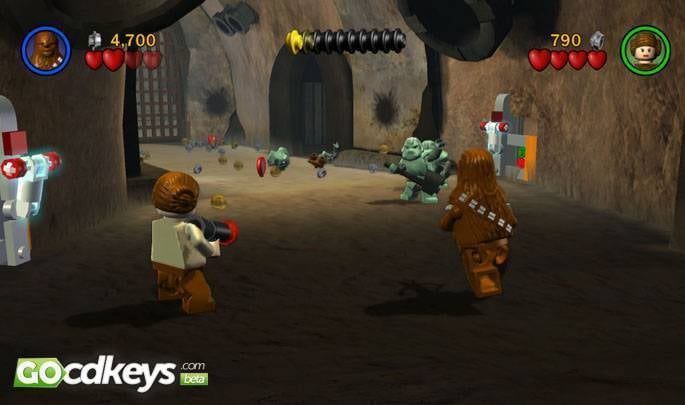
I adore LEGO Star Wars: The Complete Saga. It’s easily my favourite piece of Star Wars media, and this is including the films. But it’s far from perfect, and its collectibles are one of the reason. To be fair, the system used is optional, making it a challenge to find all the studs, LEGO canisters and red bricks, yet not mandatory to complete the game proper. Even Free Play mode simplifies collecting everything by giving you an immediate roster of playable characters, whom you can cycle through on the fly, to complete objectives that were impossible in Story mode.

The complication, however, is, again, that some of these collectibles require cycling back-and-forth between characters to access hard-to-reach areas for little-to-no reward. It’s not as bad as Donkey Kong 64, at least you don’t need to backtrack to swap out, but it can be tedious when you forget that that one cluster of studs needed to fill your Stud Meter was in an area you can’t reach without a character you haven’t purchased yet.

On top of that, LEGO Star Wars: The Complete Saga encourages exploration for the sake of unlocking Gold Bricks. But if you don’t have the patience to find that one canister, or aren’t fast enough to collect all those studs from an exploding door before they disappear, then what’s the point? The game might be way too lenient with lives, but that doesn’t mean that 100% completion isn’t still a chore. Because if me not being able to do so 10 years later is indication, then it is.

This is the trouble with collect-a-thons: they punish you for not collecting what you need to progress forward. Collectibles on their own aren’t the problem, and in small doses they can be fun to search for. But when they detract from the enjoyability factor and become a chore, well…why have them? They teach patience and perseverance, but that often becomes an addiction. And addictions aren’t healthy.


Which is probably what reviewers were concerned about with Yooka-Laylee, a fact made worse by the game adopting an aesthetic that was abandoned in the early 2000’s. And yeah, this doesn’t mean the game sucks. Unlike Mighty No. 9, it looks to be competent and playable. Chances are, even, that people will enjoy it quite a bit! But that doesn’t make the complaints less-valid. Nor does that change my outlook on collect-a-thons.

Wednesday, March 22, 2017

The "Fallacy" of the Modern Action Scene?

This, right here, is the infamous highway fight from Captain America: The Winter Soldier, aka the most-important character reveal in the film:


Macho-to-macho. Wait, that doesn’t sound right… (Courtesy of The Bosnian Dragon.)

Notice anything wrong with it? Ignoring the editing for a moment, put yourself in the shoes of an average film-goer in 2014: Captain America, up until now, was the goofy, lighthearted paragon of righteousness, as evidenced by Captain America: The First Avenger. People had been hearing stories that the follow-up film would be darker, and boy was it ever! So when this reveal was made, it was a big turning point.

So, let me ask again: notice anything wrong with this scene?


If your answer is still “yes”, you’re failing my social experiment. Because I don’t see anything seriously wrong with at all: it has narrative cohesion. It has three acts-the initial attack, the moment where Captain America goes for hand-to-hand combat, and the reveal and escape of The Winter Soldier-and flows as an action scene. The stakes build properly. There’s real threat of death, as evidenced by Black Widow getting shot in the arm. And it’s suspenseful. You can argue that it’s pedestrian compared to other movie fight scenes, but, again, nothing inherently wrong with it.

I bring this up because, as I’ve stated before, the MCU films are the punching bag of film snobs for everything that’s wrong with modern filmmaking. It’s as if the criticism is rooted in envy over something “generic” being incredibly successful. Today’s topic, the fluidity of action scenes, is no exception.

Let’s define what makes a “good” action scene. Based on personal experience, the action scene can be divided into two parts: the action, and the scene. The former is pretty self-explanatory, but the latter is really no different than any other scene in general: it must be triggered by the grander plot, it needs an arc, and the characters have to be influenced by it in some shape or form. There’s no one “right way” for this work, since films are subjective, but those components have to be there.


And that’s what’s being ignored when critics point out that the MCU “lacks good action scenes”. Because while the “action” part might not be the greatest, the “scene” part is still serviceable. In the case of the aforementioned highway fight, it’s pretty straight-forward: Captain America, Black Widow and The Falcon are ambushed by The Winter Soldier while trying to escape with a HYDRA rat. The rat is thrown into oncoming traffic, the car that everyone is in is destroyed and the three are left to fend The Winter Soldier off. Staying in hero mode, they try limiting civilian casualties, leading Black Widow to get shot in the shoulder. No sooner does The Winter Soldier attempt to finish her off when Captain America comes in for the brawl and rips off his mask, revealing his old friend, Bucky. Confused, The Winter Soldier then creates a distraction to get away, with Captain America, Black Widow and The Falcon now at the hands of HYDRA operatives. End scene.

I didn’t need multiple viewings to get that either. If anything, multiple viewings have only strengthened my ability to enjoy it, as I could pick up on details I might’ve missed the first time around. Details like what was on Black Widow’s phone screen when it exploded, or how The Winter Soldier initially looked around confused when his real name was called out, or even how the music cue during the fight was The Winter Soldier’s theme. These all enhance the fight. So, again, what’s wrong with this scene?

I’m not sure why it’s a problem that the action is a little shaky, especially given that it still functions as a scene. And to use a counter-example, let’s take a “technically better” action scene from a movie released the same year and rip it apart:


Hoo boy! (Courtesy of Ross Irving.)

From a technical standpoint, there’s nothing wrong with this scene: it’s shot well. It’s choreographed well. There are stakes involved. John Wick, the protagonist, shows he's vulnerable by taking bullet wounds and injuring his leg from being tossed from several storeys. It’s constantly energized, and critics loved it.


Except there’s a problem: you don’t learn much because it lacks intimacy. The entire scene is about John Wick trying to locate the son of a mafia boss (seen running with a towel around him) for having murdered his dog, but by scene’s end nothing’s really been accomplished. All it’s been is a showcase for bullet-laden action with several, interchangeable henchmen, which, to be honest, is kinda boring. Though, granted, the entire premise of John Wick isn’t all that exciting, so…yeah. Moving on.

You see my concern? For as much as I’ll cede that most action movies these days have shaky action, streamlining action doesn’t automatically solve the problem. Because most action movies have far bigger problems than bad action: they also suffer from bad writing and acting. And besides, an action movie can still function if its action scenes are bad, as evidenced by Batman Begins, if its writing is solid. The same can’t be said for the reverse, no matter how much people might try arguing otherwise.


This reeks of yet another attempt to discredit the MCU simply because it’s popular. That’s not to say that it’s flawless, as we’ve recently seen with Iron Fist, or even that the critiques aren’t legit, because no franchise is immune to criticism. But unless that criticism is tinged with an understanding that said franchise has an objective separate from your personal taste, then all it is is snobbery and elitism.

Besides, if the MCU’s action sequences are that “off-putting”, then perhaps this one from Captain America: Civil War will help with that:


See? The MCU has coherent action scenes too! (Ignore the edits, it was all that was available on YouTube. Clip courtesy of Movies Den.)

Monday, March 13, 2017

Ghost in the Shell: State of the Anime Address

I normally keep anime and anime-related topics away from The Whitly-Verse. For one, that sort of content is best left for Infinite Rainy Day. And two, I created The Whitly-Verse as a safe haven for other topics that I’m interested in. However, sometimes I have to make exceptions, and this is one of them. So let’s discuss Ghost in the Shell.


For those who don’t know, Ghost in the Shell is a Manga series by Japanese writer Masamume Shirow. Manga are Japanese comics, and this one was so popular that it inspired a 1995 anime film from director Mamoru Oshii. The basic premise is that a cyborg cop named Motoko Kusanagi is tasked with finding “The Puppetmaster”, who’s been hacking into people’s subconsciousness and replacing valid memories with invalid ones. Ultimately, Motoko confronts The Puppetmaster, chats with it and, reluctantly, agrees to a merger with its intellect.

Ghost in the Shell is both influenced by and has influenced Hollywood blockbusters in the late-20th Century. It incorporates its aesthetic and existentialist themes from Blade Runner, while it went on to influence the films Dark City and The Matrix. It’s as much a big deal directly in Japan as it is indirectly in the West, even if I’m, personally, not the biggest fan myself. So it should come as no surprise that there had been talks of a live-action remake for Western audiences for years. The fact that it took so long to come to fruition should be an indication that something was wrong, but add that the main character, a Japanese cyborg, was given to Scarlett Johansson, a white Jew, and you’re not helping.


Ignoring the comments made by Johansson, which I discussed here, about her casting, a recent trailer uncovered that her name had been changed from Motoko to Mira to accommodate the ethnicity change. That’s already bad enough, but the cherry on the top is a piece from this website that had this to say about the 15 minute preview shown in theatres:
“From the sneak peak footage I saw, it looks the Major is originally Japanese. Let me explain. It appears that the character is in a nearly fatal accident. This accident causes her body to be rendered useless, but her brain is the only thing that can be salvaged. So this Japanese woman whose brain is recovered is transferred into a body, or Shell, that just happens to be Scarlett Johannson’s new body. Now her name is ‘Mira.’

This is horrifying.

The ‘yellow face’ comments hold merit because there is a scene that shows Mira awakening in her new body. That particular shot is suspect as Johannson looks… well… Asian. Even the cut of her eyebrows makes me side eye. However, nothing about the Major has ever screamed WHITE WOMAN. That is in the imagination of people who default to whiteness.”
Ignoring the misspelling of Johansson’s last name, this should alarm you. I even criticized this on my Facebook page:
“I've already written about this a few times for Infinite Rainy Day, but this news makes me want to vomit. Whitewashing is already a problem as is in Hollywood, but how is THIS okay?!”
For those who still aren’t convinced that this is a problem, allow me to divulge some history:

Western media has had a history of racism. This is because of European civilization’s roots of imperialism and subjugation, and art tends to reflect societal trends. One need not look further than Oliver Twist and The Merchant of Venice for examples of this, but even in more recent decades racial stereotyping via white people, or “whitewashing”, is a big problem. It permeates almost every form of narrative and non-narrative art in some capacity, to the point where it’s become an occupational hazard.


The issues of whitewashing have started being challenged in recent years as society has moved toward globalization. The concept of there being other cultures and races worth exploring and respecting is increasingly becoming commonplace, and minority perspectives and voices are starting to be heard more and more frequently. One of the side-effects of this global voice is the demand for proper representation in art. Because, and let’s face it, whitewashing isn’t really about only whiteness.

Which leads me back to Johansson’s casting. In my second piece on Ghost in the Shell for Infinite Rainy Day, I mentioned that Johansson being unable to recognize harmful, marginalizing behaviour is unbecoming considering that she was chastised for advertising SodaStream, an Israeli company, during the Super Bowl a few years back. Her inability to reciprocate sensitivity was disappointing and hypocritical, and I expected better from her. Looking back, my critique should’ve really been directed at the studio higher-ups. Because while Johansson may not be guiltless, she’s not the real problem.

For those still unsure why this is an issue, I’ll use an easy equivalency: see this picture? Notice how it sends off negative vibes about Jews? What if a movie were made depicting Jewish culture, and the main character was a gentile dressed up in such stereotypical attire? Wouldn’t you be insulted?


That’s basically what Ghost in the Shell is doing for people of Japanese origin, except it’s not as direct. Motoko Kusanagi, or Mira, is behaving and acting like a Japanese woman despite being white, a fact not helped by inheriting the brain of a comatose, Japanese woman after an accident. On its own, this wouldn’t be a bad idea, especially since body-swapping is common in fiction and leads to excellent existentialism, but the fact that one culture is being completely absorbed by another is where the line gets drawn. Especially when the absorbing culture has a history of dominance.

It’s not even like this is being played up as satire. That would’ve been troubling, but at least the biting commentary could’ve somewhat softened the horrors of the core concept. Sadly, it would’ve required effort, and Ghost in the Shell is too busy aping the Jason Bourne and Total Recall movies to actually care. So it’s not only lazy in its appropriation, it’s lazy in its lack of self-awareness. That’s actually more scary than a simple case of whitewashing.

I don’t want to be unfair to this movie. It was in production limbo for a long time, and it’s been fraught with difficulties every step of the way. It also, judging by its aesthetic, is trying to copy the look of the original material, something anime-to-Hollywood adaptations in the past haven’t attempted. Not to mention, it’s visually arresting. It’s merely a shame that its core premise and writing are so incredibly tone-deaf, as we could’ve had a success story had someone given a damn.


And yes, I don’t think the movie will be good, which might make feeling bitter somewhat less frustrating, but the aforementioned should still terrify you. Because it terrifies me enough to write about it here, and isn’t that what really matters?

Thursday, March 9, 2017

Iron Bomb

Who’s excited for Iron Fist? I am! Marvel’s been on a roll with their Netflix shows as of late, so this seems like a perfect opportunity to get pumped. And hey, the early review embargo’s down! I wonder what critics are saying-
“Iron Fist is the most frustrating and ferociously boring example of Netflix Drift [pacing problems] in some time.”
Oh…
“I’m not surprised that Iron Fist isn’t a comedy. I’m surprised that it’s so bad. And it is laughably bad.”
Oh dear…
“If Iron Fist was an otherwise boring series with a hero who kicked butt in exciting ways early and often, I’d forgive the bland expository parts in the same way I do for a lot of action shows and movies. And if Finn Jones couldn’t fight but was otherwise a riveting screen presence blessed with sparkling dialogue and a compelling character arc, I’d get past the alleged living weapon’s lame physical prowess. But when neither part works at all, why would anyone but the most devout, masochistic Marvel completist want to watch?”
Yikes!
“Through six episodes, in addition to failing to introduce a main character I care about at all, Iron Fist hasn't given me any season-long arc/objective that I could describe for you, much less one I'm curious to see resolved.”
Oy!
“What could have been the boldest series is instead the quietest. Seriously … in the comics, the man gets his powers from punching a dragon in the heart, but that’s withheld from us? If I wanted to focus more on reality I wouldn’t spend so much time watching superhero TV.”
Oy vey zmir!
“Fans feared the worst when the series was announced, and all their fears came true.”
*Sigh* So much for that!


I should get this out of the way now: I’m not a die-hard MCU fan. I like their stuff a lot, but save Iron Man none of it strikes me as an instant classic. The exceptions are the Marvel Netflix shows, all of which, at least with their debut seasons, I’d put on-par with that film. So the newest entry, aka Iron Fist, getting panned so heavily is really crushing. It’s not like this was some low-tier series, as Marvel’s made sure to give their c-list heroes the respect they deserve so far. But with this information being made available, it’s as if that “Marvel doesn’t make bad content anymore” claim is suddenly not true anymore.

Sufficed to say, the internet’s reaction has been as you’d expect. On one hand, MCU die-hards are furious, claiming that this is “a mistake”. On the other hand, MCU detractors are smiling in devilish glee and thanking the gods of karma. And then there are those in-between that are disappointed, like me. However, both extremes need addressing, so that’s what I’ll do.

First, to the fans: calm down. This isn’t the end of the world. We knew from the beginning that the MCU quality train wouldn’t last forever. It’s impossible to keep a steady influx of shows and movies and not have at least one dud, it simply took longer than expected.


Personally speaking, I’m not upset. I know Thor: The Dark World wasn’t outright panned, but it wasn’t exactly “good” either. It was the first sign in my eyes that the MCU wasn’t infallible, and that’s because I remember so little due to how uninspired it was. It, in many ways, was the film version of Iron Fist: slow, boring and inconsequential. And yes, it introduced one of the Infinity Stones, I’m aware of that, but that it took all of the flaws of Thor-Darcy, an unenthusiastic performance from Natalie Portman, a disappointing finale, forced comedy that wasn’t funny, side characters who mostly served as window dressing-and magnified them tenfold was reason enough to be let-down. I waited until I’d earned a free movie to go see it, and I never do with an MCU film!

Honestly, take a page from Cars 2. Speaking as someone who didn’t mind Cars, I was initially excited for that film. I love Pixar, and they’d yet to make a flat-out dud by that point, so I was intrigued by the possibility of a spy film from the perspective of talking cars. I know now that my hopes were unfounded, but I also didn’t mind Cars 2 all that much. I waited until it hit home video, but it had its moments, so it wasn’t a waste of time.

And that could end up being the legacy of Iron Fist. Sure, it might plod, but who’s to say it won’t be enjoyable? Remember that critics are paid to be more critical of entertainment than the average Joe, so hearing “it’s boring” doesn’t mean that it’s actually boring. Basically, don’t be discouraged and watch it anyway.


As for those celebrating with glee, grow up. So what if an MCU property finally sucks? You want me to talk about the DCEU’s quality control? Because, rest-assured, it’s far worse! You’d think a comic enterprise like DC would know how to put out solid work in-conjunction with Warner Bros., but nope! Three attempts at a shared universe so far, three reminders that a LEGO movie is doing a better job!

Secondly, why the arrogance? I know that there’s catharsis in knowing that Marvel has finally fallen on its face, but why does this a competition? Why are you so insistent that this is a “victory” after reviewers were “bribed by Marvel to give the competition bad reviews”? Ignoring how flat-out absurd that is, shouldn’t you be encouraging good entertainment, not petty rivalry? What gives?

And thirdly, if you wanna get technical, the MCU going 14 movies, 2 shows and 3 Netflix series without a single dud should be an indication that they’re doing something right. If it took that long, then clearly they’re doing something right! It’s like how Pixar’s first flop, Cars 2, came after 11 success stories: if anything, that’s something to learn from.


Besides, Marvel’s gonna recover from this. Even if Iron Fist is a dud, they’re not stopping any time soon. They going ahead with The Defenders on Netflix, as well as Guardians of the Galaxy Vol. 2 and Thor: Ragnarok in theatres. This is a minor setback in the grand scheme, and Marvel knows this. It might hurt them a bit in the short-term, but their long-term goal is still on-track.

Ultimately, what this should prove to everyone is that Marvel’s not perfect, and that’s okay. They’ve built up a big enough empire that they can afford a slip-up. It’s no different than the aforementioned Pixar and Cars 2, or even Studio Ghibli and Tales from Earthsea. Marvel’s not out of the game, trust me! If anything, they’ll learn from this and try harder for next time (assuming they even have to, which won’t be hard.)

So yeah, Iron Fist is the first MCU dud. But it’s not the end of the world either, and I wish people would realize that.

Tuesday, March 7, 2017

X-23, and the Case for the Damaged, Human Heroine

(Note: this piece contains spoilers for Logan, as well as a few other movies and shows. You’ve been warned.)


I saw Logan recently in theatres. Irrespective of its bleak tone and depressing ending, I enjoyed it, and it’s arguably the best X-Men film to ever be made. There’s a lot that I really loved, but one detail in particular was Laura, aka X-23. Despite being assigned to newcomer Dafne Keen, as well as being a tough character to portray effectively, I was pleased by how quickly she became the best part of the movie. It’s tough when a little girl is expected to make it as an action star, but Keen carries it with ease.

Honestly, despite not being a comic book reader, I’ve always had a soft-spot for relationship between Logan/Wolverine and Laura/X-23. I remember first seeing her in X-Men: Evolution being sent out on a mission to infiltrate the X-Mansion, which was thwarted by Wolverine and forced her to come to terms with the fact that, underneath her hard exterior, she was a scared kid put through testing she never had a say in. Like Wolverine, she was a soldier never given a proper life. And while Wolverine had bonded with other mutants in the past-Jean Grey, Cyclops, Professor X, Rogue, Kitty Pryde-this was the first time we saw him be a father figure to a gender-swapped clone. So seeing that on the big-screen for the first time was a dream come true.

That got me thinking about the recent demand for action heroines in film and TV, as well as how they’ve been portrayed. The two streams of thought have been to make them either competent clones of their male-counterparts (see Supergirl), or to have them as damaged characters who fight through trauma in order to feel more…human, I guess. Both make for efficient role-models for young girls or women to latch onto, but I’m fonder of the latter category because it makes for the more relatable protagonist. Violence has predominantly been “a man’s game”, so showing the negative consequences of violence through women has led to some interesting subversions and commentaries on its implications.


Take The Hunger Games franchise. Originally written to comment on the reality TV-like nature of modern violence, it quickly became a symbol of femininity embracing and uniting the chaos of senseless bloodshed. Katniss Everdeen initially doesn’t want to be a symbol of hope, she wants to make due in a dystopian world. She has excellent archery skills, but only because she’s been relegated to breadwinner and primary caregiver following the death of her father in a mining accident. She volunteers as tribute in the Hunger Games out of a desire for her sister’s safety, which shocks everyone because it’s never been done prior.

Katniss’s journey from every-girl to heroine is fraught with complications, most-notably her battle scars from both tournaments. The first go-around, she’s forced to kill a mix of blood-hungry and scared teenagers for entertainment and survival, leaving her a victim of PTSD. The second go-around, she’s forced to do the same, except this time it’s adult victors who are tired of fighting. She finds an out via a glitch, but at the expense of almost dying and losing some powerful allies. In the final movie, she’s given a choice between shooting President Snow (the perpetuator of the system) and President Coin (the perpetuator of something worse), whereupon she shoots Coin and lets the angry mob rip Snow apart. Her decision speaks to how corruption through violence is non-ending, and that the only answer is to opt out of the system altogether.

Next, we have Jessica Jones from Jessica Jones. Like Katniss, Jessica is a reluctant heroine who’s compartmentalized her own traumas. Like Katniss, Jessica has experienced loss, this time her entire family. And like Katniss, Jessica suffers from PTSD, having been a victim of an evil man hellbent on revenge for ruining his life. But where as Katniss chooses to be a heroine in order to save a loved one, Jessica becomes a heroine in order to save herself. She’s a cranky, loud-mouthed alcoholic with a terrible temper and a no-nonsense attitude, even throwing one of her clients through a window, yet because her past won’t leave her alone she takes up the mantle to alleviate the pain.


What also makes Jessica different from Katniss is her resorting to various options first. Katniss isn’t given agency until the final arrow, but Jessica keeps making choices in her fight against Kilgrave: should I appease him? Should I reform him? Should I torture him like he tortured me? Should I bargain with him? Should I forget all of that and simply kill him? None of these are easy choices, but the violence and chaos she’s been enabling adds colour and depth to her already messed-up mind.

We can take this concept even further with the Star Wars franchise. Often considered the grandfather of modern action, the Star Wars universe, the canonical one, really gained footing with relatable, female characters starting with Ahsoka Tano in Star Wars: The Clone Wars. Initially both a padawan to Anakin Skywalker and an audience-insert, Ahsoka quickly became fleshed-out by the trials and tribulations of The Clone Wars, until she went into exile at the end of Season 5 following an unjust trial. Ahsoka would return in Star Wars Rebels’s Season 1 finale as part of The Rebellion, although her optimism would quickly turn to fear once she discovered that her former master was now a Sith Lord. The Season 2 finale ended with a fight between her and Darth Vader, and it didn’t turn out well for her at all.

What makes Ahsoka unique is how she handles her stress and trauma. She too is a broken character by the end, having been hurt by distrust and death, but she keeps her trauma in-focus. Her ultimate goal is to confront it, but she never lets that get in the way of her composure. The two times she shows vulnerability are when she faints aboard The Ghost and screams while in the Jedi Temple of Lothal, and both are a result of her former master. Even during her fight with Darth Vader, Ahsoka remains collected and firm, yet she’s no-less broken than Katniss and Jessica.


Further still, both of the recent Star Wars films feature damaged heroines who heed the call of adventure by circumstance. In the case of Star Wars: The Force Awakens, Rey is a scavenger on Jakku who longs to see her family again. In the case of Star Wars: Rogue One, Jyn Erso is a rogue insurgent who longs to see her father again. Both have buried traumas-the death of several Jedi pupils at the hands of Kylo Ren for Rey, or the death of her mother and abduction of her father by The Empire for Jyn-that they choose to ignore, and both are eventually taken to task once fate intervenes. Ultimately, Rey assumes the role of Jedi, defeats Kylo Ren and finds Luke, while Jyn becomes a rebel, steals The Death Star plans from Scariff Base and dies a symbol of hope. Both turn their pain into reasons to do good, and both are commendable role models because of it.

Which leads me back to Laura, or X-23. Like the aforementioned, she too harbours scars that shape her: she’s an experimental mutant gone awry. She longs for freedom in Eden, which is in a hideout in North Dakota. She’s insecure about her surroundings and incredibly paranoid, always attacking what scares her. And yet, she’s fiercely loyal to Logan and Professor Xavier, considering them to be surrogate father and grandfather figures. Also, she’s an incredibly agile fighter.

Surprisingly, we learn all of this through minimal-to-no dialogue; in fact, Laura doesn’t even say a word until two-thirds into the film, let-alone in English until they arrive at Eden. Her communication remains minimal, preferring grunts, yells and bodily actions. She’s incredibly primal, yet her relationship to Logan makes her human and learn independence. By the time Logan’s inevitable death occurs, Laura’s completely self-sufficient.


Ultimately, what makes these individuals heroic is their humanity. They’re not superficially powerful, nor are they 100% peachy. They might smile and laugh occasionally, but for the most part they’re troubled, broken individuals looking for gratification or redemption. It might not always be pleasant, but it’s always believable and satisfying. And I recognize that creating damaged characters isn’t always the correct storytelling choice, but it’s still a viable way of writing them for girls longing for relatable heroines.

As for Logan? Well, I stand by what I said at the beginning: it’s bleak and depressing, yet also incredibly satisfying. This is the perfect send-off for a character I’ve grown to care about for 17 years, and I couldn’t have asked for more. I also couldn’t have asked for a better break-out role from Dafne Keen. My only hope is that other comic book adaptations understand why this movie worked should imitators spring up, although I doubt that’ll happen.

Thursday, March 2, 2017

The "Villain Problem" in Disney Films

Doug Walker, aka The Nostalgia Critic, is a man that I respect. I especially like how his recent trend, i.e. the past few years, has been alternating between a review and an editorial, as it gives variety and colour to a concept that was clearly getting old and boring. But every-so-often he says something I disagree with, hence today’s discussion:


Hmm… (Courtesy of Channel Awesome.)

Now, Doug has a point: modern Disney villains lack the finesse of classic ones. It’s something I’ve noticed myself, especially since Disney antagonists haven’t had a solo number in almost 7 years, or a memorable one in almost 8. Disney’s villains, put plainly, aren’t as stand-out as they used to be, and as a Disney fan this is disappointing. However, to say this is bad, or even that they’re not memorable, is misleading. Because it’s not true.

I don’t think villain culture in movies is healthy. It’s not “bad writing” to have them in films from-time-to-time, but it’s no different than, say, drinking beer. An occasional cold one with friends is fine, but too much can lead to drunkenness, alcoholism and erratic behaviour. Also, those hangovers are a killer! Movie villains, though not quite the same, are like that beer, as too many can warp your mind and make you think that all of life’s problems can be be solved by fighting the big-baddie and not have compromise or co-operation.

Allow me to use three examples to demonstrate that. First, the MCU. For all of its strengths and weaknesses, the one area that people agree on is that the baddie roster is pretty weak. Most of the antagonists consist of a “monster of the week” formula, except replace “monster” with “villain” and “week” with “film”. They exist to challenge the hero in the finale and die horribly, that’s it. Their motivations are weak, their arcs are flat and they’re boring.

There are exceptions, however. Loki, for instance, became a fan-favourite with The Avengers, due, in-part, to Joss Whedon liking the character and upgrading him from his outing in Thor. I’d argue that Zemo from Captain America: Civil War was also strong, although he wasn’t the focus of that movie anyway. But then there are the Netflix villains, all of whom get the advantage of time to be fleshed-out. However, the key is believability in motivations, something a great villain needs. You need to understand or sympathize with the baddie to an extent.

Next up, Star Wars. The franchise practically thrives off of villains, but none are more iconic than Darth Vader. He’s been in seven movies and has had direct and indirect development in two shows. He looks cool, sounds cool and has been part of one of the greatest plot twists ever. Surely he’s a great villain, right?


Well…kinda. Darth Vader didn’t start out deep. He arguably wasn’t even given a character-arc until the conclusion of The Original Trilogy. Even the Prequels, for all their flaws, fleshed-out dimensions to his character. For the most part, he was a stereotypical bad guy, irredeemable and shallow. He was memorable, but not complex.

I mention this because two other antagonists in the Star Wars universe have more life and complexity than him. The first is Kylo Ren, who manages to be more humanized in one film than Darth Vader was in six by, ironically, trying to mimic him. You saw his inner-strife, constantly being torn by the Light and Dark sides of The Force. He was an awful person, don’t mistake me, but he’s was still sympathetic. He wasn’t your typical Star Wars baddie, in other words.

The other one is Grand Admiral Thrawn, who’s become more popular since his inclusion in Season 3 of Star Wars Rebels. Thrawn isn’t deep either, but his composure is human: he’s well-behaved. He rarely loses his cool. He speaks in a quiet register. He’s clever, cold and calculating, always reading his opponents like an expert chess player. As a result, he’s really interesting and creepy, and he has much more depth than Darth Vader.

The reason I mention these two characters is to reemphasize the point about shallow villains: they’re not as interesting. It took a 2-minute scene at the end of Star Wars: Rogue One to finally make Darth Vader scary, and part of that was the lighting (or lack thereof) in it. Meanwhile, Thrawn is creepy by sheer fact that he’s never angry. It took two trilogies, a spin-off film and two shows to give Darth Vader a complete arc. Meanwhile, Kylo Ren was interesting instantaneously. Villains are like any other characters, in that the best ones are the best-written ones.


Finally, let’s discuss one of my favourite living directors: Hayao Miyazaki. Miyazaki is an anime director known for being critical of his industry. That said, his philosophy on villains in film is fascinating, as he’s not fond of the traditional antagonist:
“The concept of portraying evil and then destroying it - I know this is considered mainstream, but I think it is rotten. This idea that whenever something evil happens someone particular can be blamed and punished for it, in life and in politics is hopeless.”
It’s worth noting that Miyazaki has done traditional villains before. Colonel Muska was a fun baddie in Castle in the Sky, while Count Cagliostro was a menacing creep in The Castle of Calgiostro. Both films made their antagonists devious and slimy, and both suffered at the hands of their own arrogance. Miyazaki wrote these characters to be hated, but they were also written early on in his career, and I doubt he’d make them that way had they come out now.

For the most part, Miyazaki’s villains are complex and multi-layered. They might commit evil or selfish acts, but it’s usually in the name of understandable motives. Princess Kushana in Nausicaä of the Valley of the Wind wants to beat her family at their own game of domination, while Spirited Away’s Yubaba is trying to make a living. And then there’s Lady Eboshi from Princess Mononoke, who, while villainous, is shown as kind and nurturing to her community. The people of Iron Town look up to and respect her, and not without good cause. In fact, that she takes up villainy because she’s blackmailed by Jigo, a monk out for self-glory, makes her somewhat tragic.


Then there are the films where Miyazaki has no villain at all, or keeps it metaphorical. The antagonist in My Neighbor Totoro is mortality, and only in the last 20 or so minutes. The antagonist in Kiki’s Delivery Service is self-doubt. The antagonist in Porco Rosso is the growing tide of fascism. Even Ponyo, which starts with a villain in Fujimoto, is really about over-protective fathers. This hits home far more than a black-and-white baddie, especially in a family movie. Sure, having someone to hate is fine…but sooner or later you have to accept that life doesn’t work that way. Kids need to learn that life is more complicated than good or bad, and that’s something I applaud Hayao Miyazaki for with his films.

Which leads back to why I think Doug missed the point with his editorial. Yeah, the classic Disney villains are fun. Yeah, I miss villainous musical cues. But to say that modern Disney villains aren’t memorable is missing the reality that, yeah, they kinda are. They’re simply not the 2-dimensional cut-outs of the 20th Century, and that’s fine. Depth can make for additional intrigue, something kids' films need badly. And if the film has no villain and still works, like Inside Out, then kudos! It’s equally important for children to understand that people are capable of being their own enemies, and that working to fix that is more important than a baddie of the week.

Then again, I think that Frozen’s third-act villain reveal was weak, so what do I know?

Popular Posts (Monthly)

Popular Posts (General)